Accelerating GLM-5.2 on AMD Instinct MI355X: EvalScope Benchmarks with Prefix Caching#

GLM-5.2 combines a large Mixture-of-Experts (MoE) architecture, sparse attention, and long-context processing. At long input lengths, this combination creates bottlenecks across GPU compute, memory bandwidth, and inter-GPU communication. Tuning a single kernel is not enough; the parallelization strategy, KV-cache layout, collective communication, kernels, and serving framework must be optimized together.
This study focuses on three production-oriented benchmark choices. First, we use EvalScope instead of a framework-native benchmark client. Second, the 64K and 128K workloads use a 90% shared-prefix configuration to represent prefix-cache-heavy serving. Third, we extend the evaluation to a 1M-token input. These workloads more closely reflect long-context deployment service-level objectives (SLOs) than commonly used uncached 1K or 8K input shapes.
In this blog, we accelerate GLM-5.2 FP8 inference on eight AMD Instinct™ MI355X GPUs through end-to-end optimizations across the inference stack. The work includes prefill context parallelism (CP8), AITER sparse-attention (DSA) kernels, PyHIP MoE tuning, custom all-reduce, FP8 KV-cache optimization, attention-kernel tuning, small-kernel fusion, GEMM tuning, and EAGLE multi-token prediction (MTP). EvalScope measurements show peak throughput increasing from 163K to 629K tok/s at 64K and from 137K to 553K tok/s at 128K. At a 1M-token input length and concurrency 1, throughput increases from 22K to 157K tok/s, a 7.16× improvement. GSM8K validation shows that the optimized stack preserves model accuracy.
GLM-5.2 Optimization Overview#
GLM-5.2 uses 64 attention heads and a hidden size of 6,144. At each layer, Multi-head Latent Attention (MLA) compresses each token into a 512-dimensional latent representation and a 64-dimensional rotary position embedding (RoPE) component. The MoE block contains 256 routed experts and one shared expert, with each token activating eight routed experts.
We deploy the FP8 model with SGLang on eight AMD Instinct MI355X GPUs, targeting long-context requests with high prefix-cache hit rates. This workload stresses sparse attention, KV-cache capacity and bandwidth, MoE communication, and dense matrix multiplication at different stages of inference. Addressing only one kernel leaves other parts of the execution path as bottlenecks.
The optimized configuration uses the following core settings:
Area |
Configuration |
|---|---|
Prefill parallelism |
CP8 |
Attention heads per rank |
64 |
Attention backend |
AITER DSA |
KV cache |
FP8 ( |
MoE |
PyHIP and AITER-optimized execution |
Speculative decoding |
EAGLE: 4 steps, top-k = 1, and 5 draft tokens |
Context Parallelism for DSA#
With tensor parallelism (TP8), each rank processes only eight of the model’s 64 attention heads. However, the Lightning Indexer selects one set of KV indices for each query token and shares it across all heads, so every rank loads the same selected KV entries. The AITER kernels used by this path also require supported head counts to be multiples of 16, which means an eight-head input must be replicated to 16 heads.
Prefill context parallelism partitions query tokens instead of attention
heads. Each rank therefore retains all 64 heads while processing one-eighth
of the tokens. This removes redundant KV loads and head replication and
lets the MI355X use its native gqa:64 assembly-optimized MLA kernel
directly.
A query processed on one CP rank can select KV positions anywhere in the full history, including cached prefixes outside its local token partition. We added the required SGLang support for CP metadata, KV reconstruction and gathering, tensor layouts, and numerical edge cases. These changes enable reliable CP8 prefill while presenting a 64-head (H64) input shape to the downstream FP8 attention kernel.
FP8 KV Cache and Fused Query Quantization#
Using fp8_e4m3 for the KV cache reduces its memory footprint and enables FP8
attention kernels for long contexts. The query projection still produces BF16
output, so the query tensor must be quantized before attention.
The original dynamic quantization path launches multiple operators and materializes intermediate tensors. We fuse the quantization pipeline into a single Triton kernel and reuse a persistent device buffer, reducing kernel launches, temporary allocations, and memory traffic. Operator-level comparisons on captured model data verified the numerical behavior, and the GSM8K validation later in this post confirms end-to-end accuracy.
64-Head FP8 Persistent MLA#
CP8 preserves all 64 attention heads on each rank. For A8W8 execution with FP8 queries and an FP8 KV cache, AITER handles this H64 shape through its persistent MLA implementation. We provide the required scheduling metadata and buffer lifecycle management so the native H64 FP8 MLA kernel runs reliably on MI355X.
MoE Execution and Communication#
With CP8, each GPU initially holds one-eighth of the tokens. The standard MoE path gathers BF16 hidden states and then repeats router and top-k computation over the full token set on every GPU.
The optimized PyHIP path moves router/top-k and activation quantization before the collective operation. It gathers FP8 hidden states, scales, and routing results instead of BF16 hidden states, reducing the communication payload per token from 12,288 bytes to 6,408 bytes and avoiding repeated routing work for non-local tokens. Unsupported shapes fall back to the standard path. The MoE path also uses AITER’s block-scale FP8 kernel and a custom collective implementation to reduce communication overhead.
GEMM Tuning#
The model architecture and parallel configuration produce a predictable set of dense GEMM shapes. We tune the block-scaled FP8 A8W8 and BF16 paths separately using offline benchmarks and store the best configurations in AITER’s tuning table. At runtime, AITER selects the tuned kernel based on the matrix shape and quantization type.
EAGLE Multi-Token Prediction#
Long-context prefill is dominated by compute and communication, while decode is typically memory-bound. The optimized stack enables EAGLE multi-token prediction (MTP) with request-level data parallelism and expert parallelism to improve decode efficiency.
To make EAGLE reliable with sparse data parallelism, we synchronize CUDA Graph replay and eager execution decisions across ranks, skip metadata generation for idle ranks, and size draft-token post-processing buffers to the actual number of active rows. These changes prevent divergent collective sequences and padded rows from affecting tokens, hidden states, or positions.
End-to-End Performance on 8× MI355X#
Test Environment#
Component |
Version / Configuration |
|---|---|
Hardware |
8× AMD Instinct™ MI355X GPUs ( |
ROCm |
7.2.4 |
Baseline server image |
|
Optimized server image |
|
Model |
|
Benchmark framework |
EvalScope |
API |
OpenAI-compatible |
Dataset |
EvalScope random dataset |
ISL / OSL |
64K / 1, 128K / 1, and 1M / 1 |
Install EvalScope:
python3 -m pip install evalscope
evalscope --version
The launch and benchmark scripts used in this section are published alongside
this blog: launch_baseline.sh,
launch_optimized.sh, and
run_evalscope.sh. Download them into a
scripts/ directory next to your working directory and make them executable
before running the commands below.
Reproducing the Baseline#
The baseline uses
lmsysorg/sglang-rocm:v0.5.13.post1-rocm720-mi35x-20260618.
Set MODEL_PATH to a prepared zai-org/GLM-5.2-FP8 model directory, and
then launch the server:
MODEL_PATH=/path/to/GLM-5.2-FP8 ./scripts/launch_baseline.sh
Run the three benchmark profiles against port 30000:
MODEL_PATH=/path/to/GLM-5.2-FP8 ./scripts/run_evalscope.sh 64k 30000
MODEL_PATH=/path/to/GLM-5.2-FP8 ./scripts/run_evalscope.sh 128k 30000
MODEL_PATH=/path/to/GLM-5.2-FP8 ./scripts/run_evalscope.sh 1m 30000
Reproducing the Optimized Stack#
The optimized stack uses sabreshao/sglang:glm_0831.
Launch it with the same model:
MODEL_PATH=/path/to/GLM-5.2-FP8 ./scripts/launch_optimized.sh
Run the same profiles against port 30001:
MODEL_PATH=/path/to/GLM-5.2-FP8 ./scripts/run_evalscope.sh 64k 30001
MODEL_PATH=/path/to/GLM-5.2-FP8 ./scripts/run_evalscope.sh 128k 30001
MODEL_PATH=/path/to/GLM-5.2-FP8 ./scripts/run_evalscope.sh 1m 30001
The benchmark script applies the profile-specific input lengths and concurrency settings shown in the test environment table. It flushes the prefix cache before each case.
Performance Results#
The following tables report EvalScope total throughput for cases with zero request failures. They focus on prefill, which dominates end-to-end time at this SLO.
64K Throughput#
Concurrency |
Baseline (tok/s) |
Optimized (tok/s) |
Speedup |
|---|---|---|---|
1 |
97,998 |
167,839 |
1.71× |
2 |
152,796 |
281,523 |
1.84× |
4 |
162,559 |
397,922 |
2.45× |
8 |
157,990 |
478,381 |
3.03× |
16 |
157,298 |
569,362 |
3.62× |
32 |
158,977 |
618,794 |
3.89× |
50 |
158,201 |
628,866 |
3.97× |
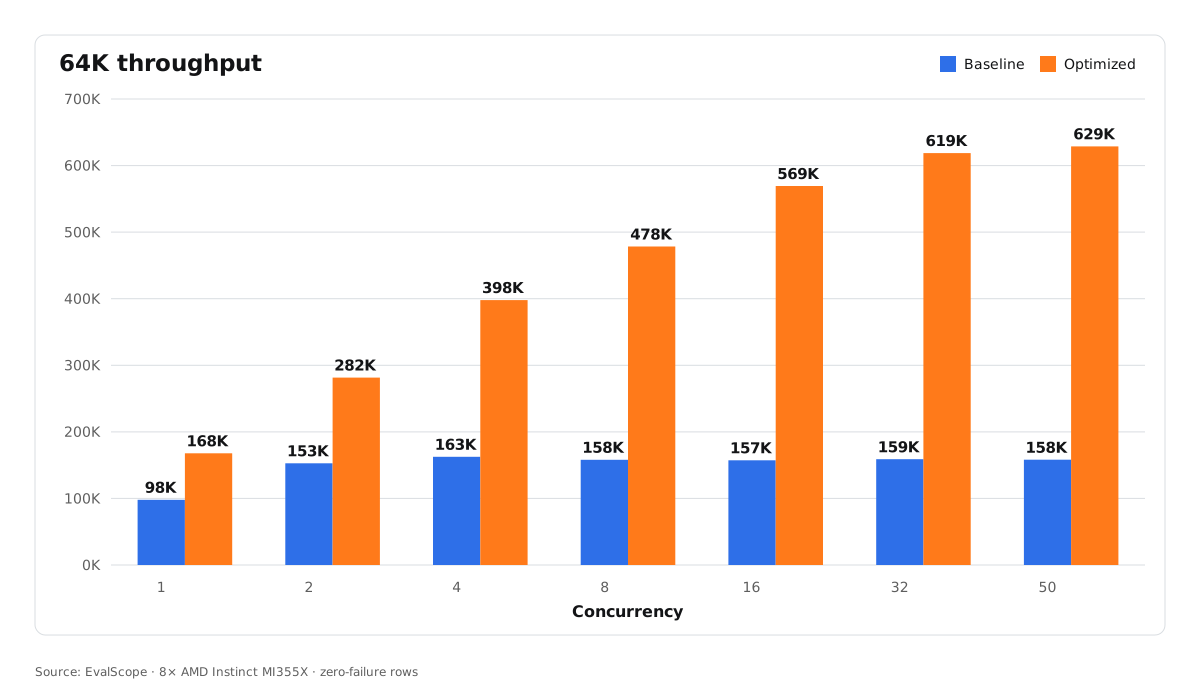
Peak throughput increases from 163K tok/s at concurrency 4 on the baseline to 629K tok/s at concurrency 50 on the optimized stack. As Figure 1 below shows, the baseline flattens after concurrency 4 while the optimized stack keeps scaling to concurrency 50.
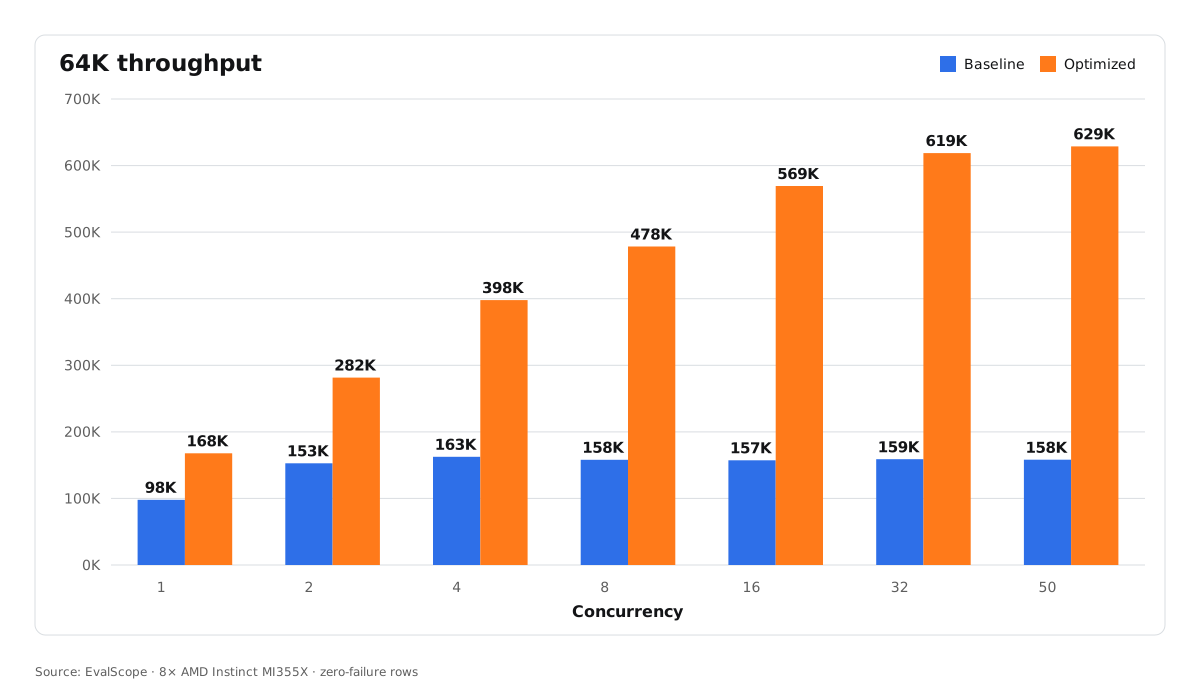
Figure 1. Baseline and optimized GLM-5.2 throughput across concurrency
levels at a 64K input length. Plotted from the table above; figure source:
glm52-prefill-throughput-64k.svg.
128K Throughput#
Concurrency |
Baseline (tok/s) |
Optimized (tok/s) |
Speedup |
|---|---|---|---|
1 |
106,036 |
215,096 |
2.03× |
2 |
136,726 |
304,338 |
2.23× |
4 |
124,239 |
455,493 |
3.67× |
8 |
130,170 |
552,896 |
4.25× |
16 |
130,413 |
535,466 |
4.11× |
32 |
131,037 |
553,018 |
4.22× |
50 |
130,591 |
528,439 |
4.05× |
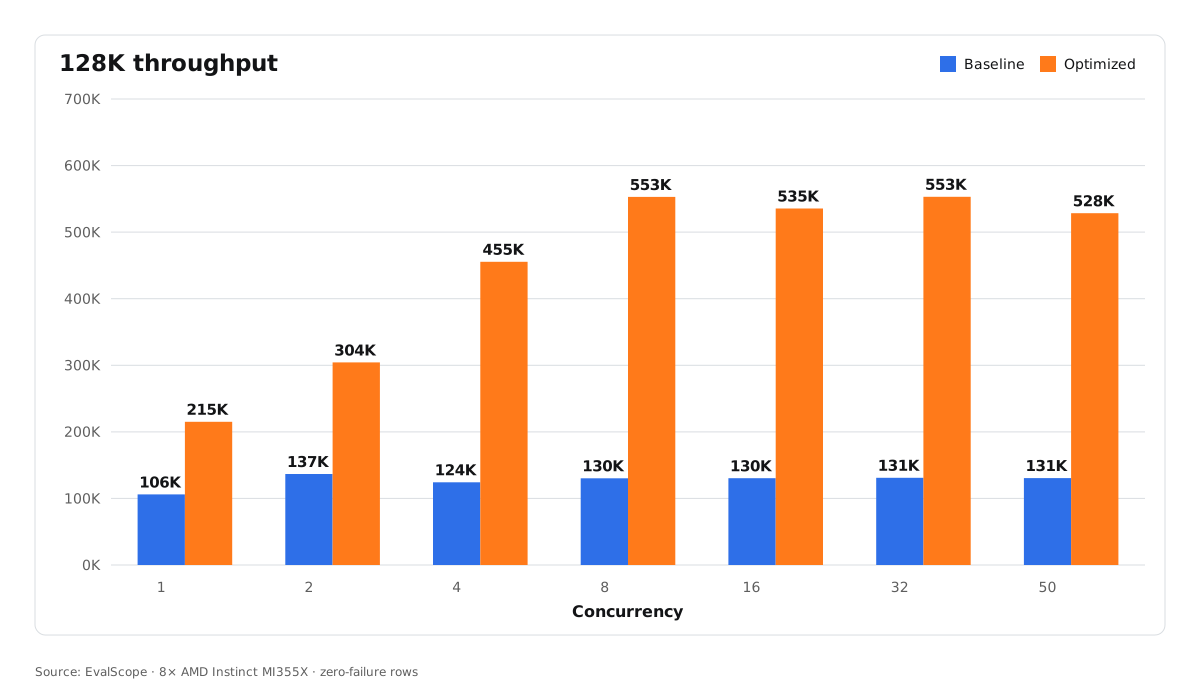
Peak throughput increases from 137K tok/s at concurrency 2 to 553K tok/s at concurrency 32. Figure 2 below shows the same pattern as at 64K, with the gap between the two stacks widening as concurrency grows.
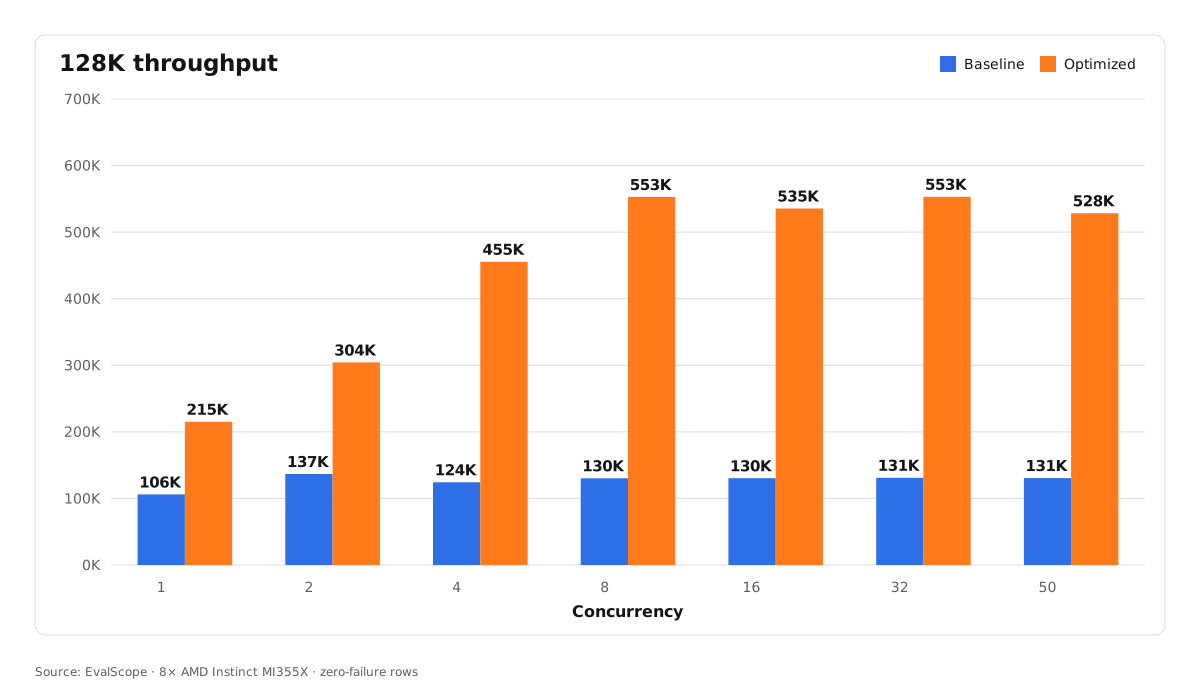
Figure 2. Baseline and optimized GLM-5.2 throughput across concurrency
levels at a 128K input length. Plotted from the table above; figure source:
glm52-prefill-throughput-128k.svg.
1M Throughput and Latency#
Configuration |
Total throughput (tok/s) |
Average TTFT (ms) |
|---|---|---|
Baseline |
21,877 |
45,660 |
Optimized |
156,598 |
6,340 |
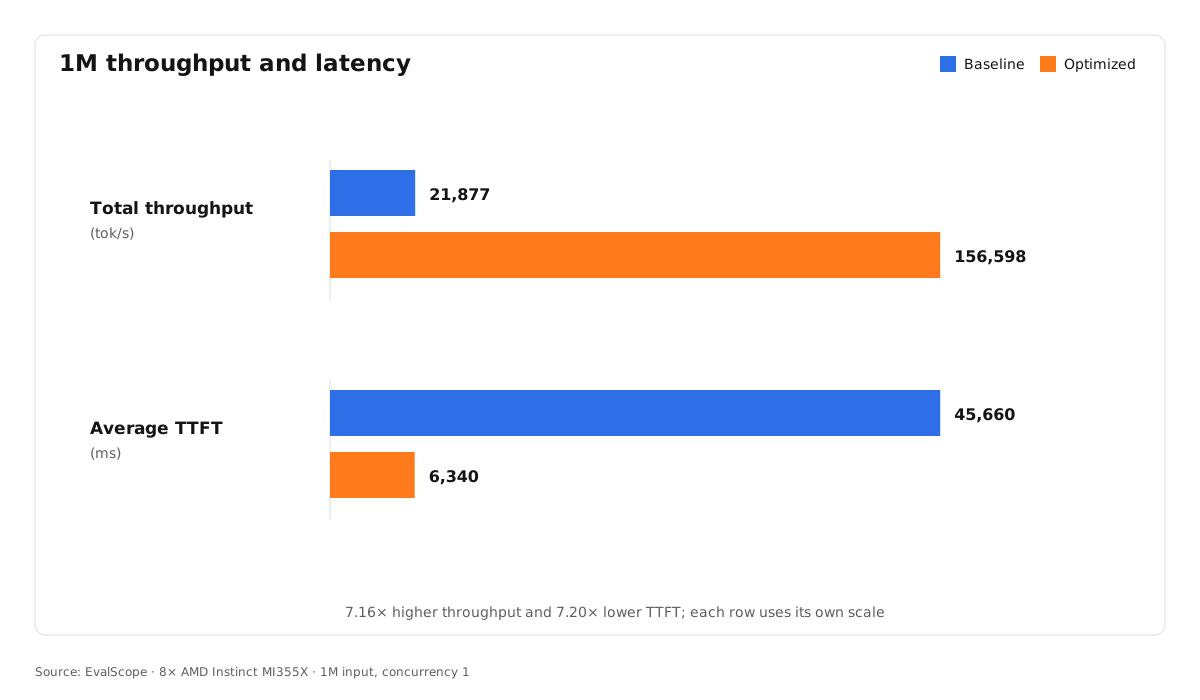
At concurrency 1, the optimized stack delivers a 7.16× throughput improvement at the 1M-token input length. Figure 3 below places that gain next to the corresponding drop in average TTFT, from 45,660 ms to 6,340 ms.
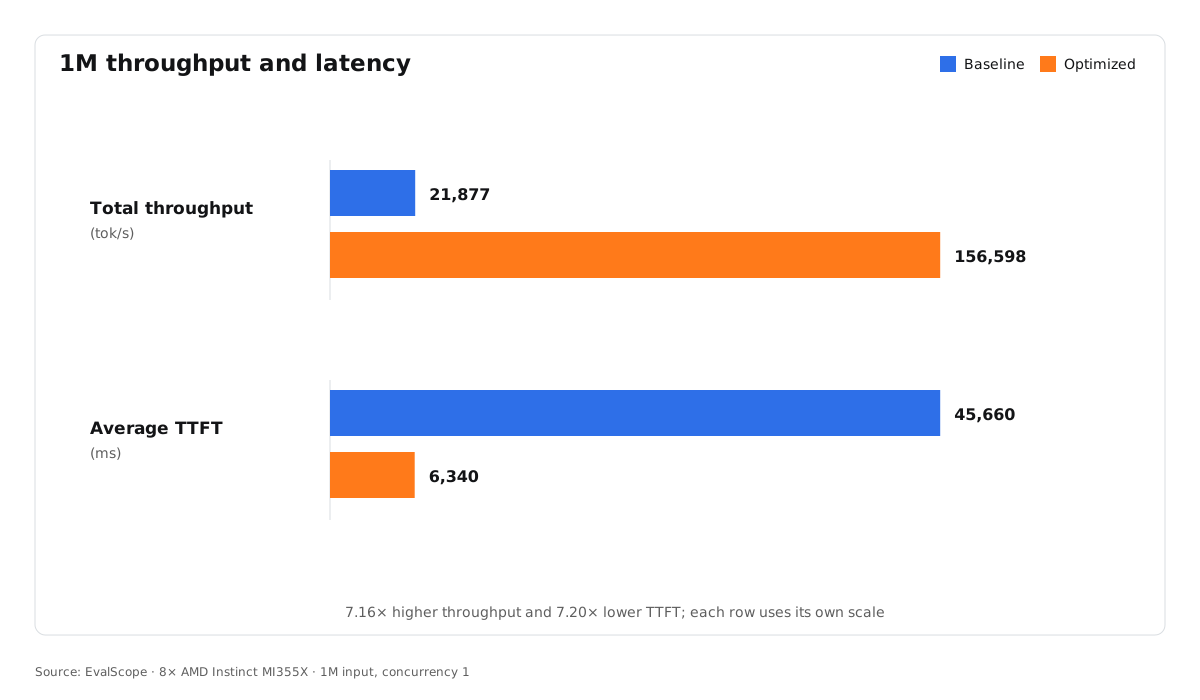
Figure 3. Baseline and optimized GLM-5.2 throughput and average TTFT at a 1M
input length and concurrency 1. Plotted from the table above; figure source:
glm52-prefill-throughput-1m.svg.
Accuracy Validation#
GSM8K (5-shot, full 1,319-sample test set) shows no accuracy regression after enabling the optimized stack.
Configuration |
Correct / Total |
Accuracy |
|---|---|---|
Baseline |
1242 / 1319 |
94.16% |
Optimized (this work) |
1252 / 1319 |
94.92% |
Both configurations used sequential /v1/completions requests with
deterministic sampling. The optimized run completed with zero request errors.
Summary#
This blog demonstrates how to optimize GLM-5.2 FP8 inference on eight AMD Instinct MI355X GPUs for production-oriented, long-context workloads. The EvalScope benchmarks use 90% shared prefixes at 64K and 128K input lengths and also evaluate a 1M-token input.
Peak prefill throughput increases from 163K to 629K tok/s at 64K and from 137K to 553K tok/s at 128K. At a 1M-token input and concurrency 1, throughput increases from 22K to 157K tok/s, a 7.16× improvement. The optimized stack also achieves 94.92% GSM8K accuracy, compared with 94.16% for the baseline.
The gains result from optimizing the full inference path: CP8 prefill, AITER DSA and persistent MLA kernels, FP8 KV cache, fused query quantization, PyHIP MoE and communication tuning, tuned GEMM configurations, and EAGLE MTP. Together, these techniques provide a scalable foundation for serving GLM-5.2 with long inputs and frequently reused prefixes while preserving model quality.
Additional Resources#
Disclaimers#
The information presented in this document is for informational purposes only and may contain technical inaccuracies, omissions, and typographical errors. The information contained herein is subject to change and may be rendered inaccurate for many reasons, including but not limited to product and roadmap changes, component and motherboard version changes, new model and/or product releases, product differences between differing manufacturers, software changes, BIOS flashes, firmware upgrades, or the like. Any computer system has risks of security vulnerabilities that cannot be completely prevented or mitigated. AMD assumes no obligation to update or otherwise correct or revise this information. However, AMD reserves the right to revise this information and to make changes from time to time to the content hereof without obligation of AMD to notify any person of such revisions or changes. THIS INFORMATION IS PROVIDED “AS IS.” AMD MAKES NO REPRESENTATIONS OR WARRANTIES WITH RESPECT TO THE CONTENTS HEREOF AND ASSUMES NO RESPONSIBILITY FOR ANY INACCURACIES, ERRORS, OR OMISSIONS THAT MAY APPEAR IN THIS INFORMATION. AMD SPECIFICALLY DISCLAIMS ANY IMPLIED WARRANTIES OF NON-INFRINGEMENT, MERCHANTABILITY, OR FITNESS FOR ANY PARTICULAR PURPOSE. IN NO EVENT WILL AMD BE LIABLE TO ANY PERSON FOR ANY RELIANCE, DIRECT, INDIRECT, SPECIAL, OR OTHER CONSEQUENTIAL DAMAGES ARISING FROM THE USE OF ANY INFORMATION CONTAINED HEREIN, EVEN IF AMD IS EXPRESSLY ADVISED OF THE POSSIBILITY OF SUCH DAMAGES.
Third-party content is licensed to you directly by the third party that owns the content and is not licensed to you by AMD. ALL LINKED THIRD-PARTY CONTENT IS PROVIDED “AS IS” WITHOUT A WARRANTY OF ANY KIND. USE OF SUCH THIRD-PARTY CONTENT IS DONE AT YOUR SOLE DISCRETION AND UNDER NO CIRCUMSTANCES WILL AMD BE LIABLE TO YOU FOR ANY THIRD-PARTY CONTENT. YOU ASSUME ALL RISK AND ARE SOLELY RESPONSIBLE FOR ANY DAMAGES THAT MAY ARISE FROM YOUR USE OF SUCH THIRD-PARTY CONTENT.
AMD, the AMD Arrow logo, AMD Instinct, ROCm, and combinations thereof are trademarks of Advanced Micro Devices, Inc. Other product names used in this publication are for identification purposes only and may be trademarks of their respective companies. © 2026 Advanced Micro Devices, Inc. All rights reserved.