Featured Posts

ROCm 10.1: Breaking the Data-Movement Bottleneck
ROCm 10.1 targets the data-movement bottleneck with AMD Infinity Storage, NUMA-aware memory, and a modernized stack.

Technical Dive into AMD MLPerf Inference v6.1 Submission
Learn about the ROCm optimizations powering dlrm-v3, llama2-70b, and gpt-oss-120b performance.

A Deep Dive into LDS Optimizations on AMD Instinct MI450 GPUs
Learn how to optimize LDS traffic in Gluon kernels on AMD Instinct MI450 GPUs using transposed loads and partition-conflict-free layouts.

ROCm 10.0: A Decade of Open Compute, Built for the Age of Agentic AI
Explore what's new in ROCm 10.0, headlined by ROCm.AI, the ROCm CLI, AMD Skills, and Hyperloom, alongside the ROCm Core SDK and platform-wide improvements

FP16 GEMM Optimization on AMD RDNA™ 3 and RDNA™ 4 Architectures
Learn how to build an FP16 GEMM kernel with WMMA on AMD RDNA 3 and RDNA 4, one optimization at a time, and approach hipBLASLt performance.

Long Context, One Node: Serving GLM-5.3-FP8 on MI300X with DP8+EP8
Learn how to serve GLM-5.3-FP8 on one AMD Instinct™ MI300X node with DP8+EP8 and vLLM v0.28 for long-context workloads, and compare it with TP=8.

AMD Instinct MI455X vs MI355X: A Technical Look at the Advancing AI 2026 Inference Numbers
Explore the MI455X vs MI355X inference numbers from Advancing AI 2026, and learn how each benchmark was measured and what it really means.

DI Series: Serving Kimi-K3 MXFP4 Wide-EP Disaggregated on AMD Instinct MI300X and MI325X
Learn how to serve a 1.4 TiB Kimi-K3 MXFP4 mixture-of-experts model disaggregated across AMD Instinct MI300X and MI325X GPUs.

Pre-Training Hybrid LLMs from Scratch in Primus on AMD Instinct™ GPUs
Pre-train hybrid LLMs mixing MLA attention with Gated DeltaNet, Kimi Delta Attention and Mamba2 mixers on AMD Instinct MI355X GPUs, with open recipes.

Completing the GPU Performance Picture: Understanding TAF Alongside Peak FLOPs and MAF
Learn how Typical Attained FLOPs complements Peak FLOPs and Max-Achievable FLOPs, including the methodology and MI325X results
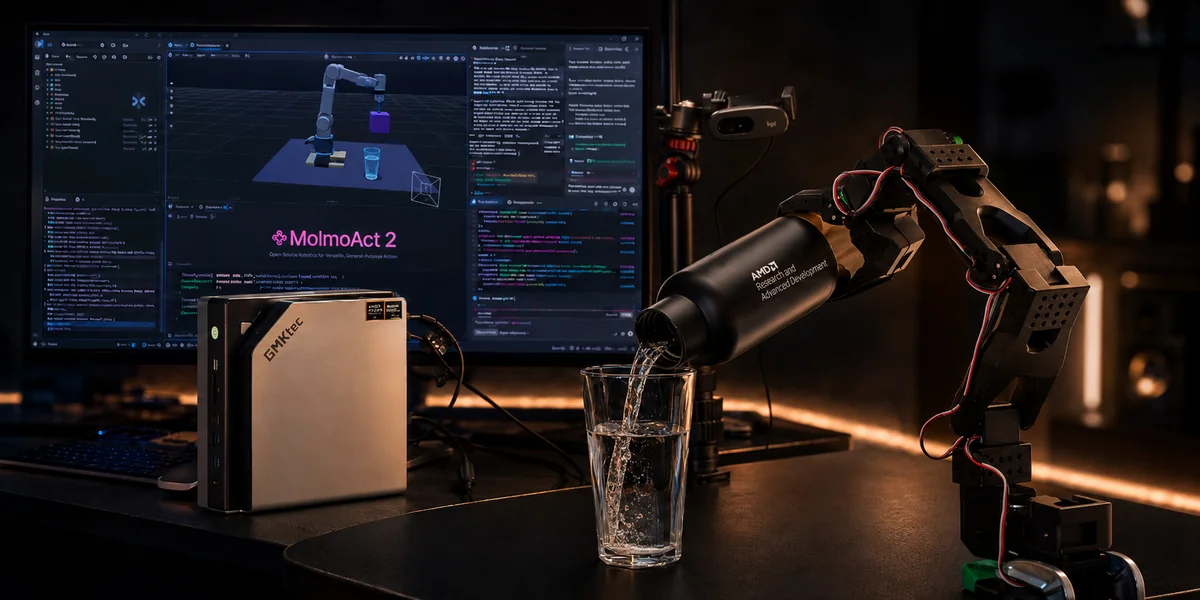
Running MolmoAct2 Robot Policy on an AMD Ryzen AI Max+ 395 Mini PC
In this tutorial, users are introduced to a state of the art vision-language-action model and the steps to implement the model directly optimized for the AMD Ryzen AI Max+ 395 Computer.

AIM: Unified User Experience from Profile Discovery to Deployment
Learn how AIMs offer a unified user experience as you explore and deploy them across AMD Instinct, Radeon PRO, and EPYC.

Automating Performance Bottleneck Identification with the TraceLens Agent
TraceLens Agent is an agentic workflow that examines GPU traces to deliver a prioritized optimization report, detailing root causes and fixes.

UltraQuant on AMD Instinct: More Efficient Agentic Serving for Qwen3.8-MXFP4
A native 4-bit MXFP4 KV cache that speeds up Qwen3.8 decode over 8-bit KV on AMD Instinct MI355X, with no accuracy loss.

Debugging Logprob Mismatches in LLM Reinforcement Learning
Learn to debug logprob mismatches between rollout and training with Qwen3 examples on AMD Instinct MI355X GPUs.

Performance Profiling on AMD GPUs - Part 6: Advanced Thread Trace (ATT) - The Microscope for Your Application
Explore rocprofv3 ATT and ROCprof Compute Viewer to trace GPU kernels and explain stalls, waits, and memory-bound performance.

Enabling Physical AI Agents with Lemonade
Learn to deploy local agents for interactive robot arm manipulation using the Lemonade framework.

AUP Learning Cloud: Streamlining AI Education on AMD
An all-in-one ROCm JupyterHub platform that deploys GPU-ready AI teaching environments on AMD hardware with one installer and open-source teaching labs.

Introducing AMD CDNA™ 5 and the AMD Helios™ Rackscale Solution
Introducing AMD CDNA 5, the AMD Instinct MI455X GPU, and the AMD Helios rackscale solution: an open, integrated platform for rack-scale AI.

ROCm 7.14: TheRock Goes Production and Expands AMD's AI Software Platform
Explore what's new in ROCm 7.14: TheRock goes production, expanded hardware support, stronger AI frameworks, and enhanced profiling tools.
Stay informed
- Subscribe to our RSS feed (Requires an RSS reader available as browser plugins.)
- Signup for the ROCm newsletter
- View our blog statistics
- View the ROCm Developer Hub
- Report an issue or request a feature
- We are eager to learn from our community! If you would like to contribute to the ROCm Blogs, please submit your technical blog for review at our GitHub. Blog creation can be started through our GitHub user guide.