FlashInfer on ROCm 10.1: The FlashInfer API with Automatic Kernel Routing#

FlashInfer1 is an open-source library of attention and large language model (LLM) serving kernels. FlashInfer on ROCm™ brings its API to AMD Instinct™ GPUs, and this release continues from the prefill-attention release. Cascade attention, multi-head latent attention (MLA), and the standalone rotary position embedding (RoPE) ops, all in progress then, have now landed. New in this release are 8-bit floating-point (FP8) prefill, POD-Attention (prefill and decode overlapped in one kernel), fused mixture-of-experts (MoE), and AI Tensor Engine for ROCm (AITER) decode under CUDA graph capture. All of it runs on CDNA3 (gfx942: MI300X and MI325X)2 and CDNA4 (gfx950: MI350X and MI355X)3 GPUs.
The point of FlashInfer on ROCm is the FlashInfer API itself: the same wrappers and the same plan() and run() model as on CUDA. The decode, prefill, and MLA wrappers keep the signatures of upstream FlashInfer v0.6.18, argument order included, so a call written for FlashInfer on CUDA binds the same arguments on ROCm. What does not carry over is listed in the support matrix below and in the repository’s backend notes.
Behind that API, FlashInfer on ROCm combines its own in-tree Heterogeneous-computing Interface for Portability (HIP) kernels with specialized libraries from the ROCm ecosystem where they serve a call well. Today that is AITER4, AMD’s library of tuned kernels for Instinct GPUs, built on Composable Kernel (CK Tile)5, hand-written assembly, and HIP. Which library serves a call is a backend detail: the API, and the code that calls it, stay the same.
The default backend="auto" makes the choice per call, following routing rules set by AMD’s own testing and benchmarking on both CDNA3 and CDNA4, so callers get AMD’s routing choice without changing any code. In this blog, you will explore what FlashInfer on ROCm supports, how backend="auto" routes each call, how an in-tree kernel uses a CDNA4 instruction, and how to build FlashInfer on ROCm and use it to serve a batch of chat requests.
What’s New in This Release#
One API, Routed by backend="auto"#
Single, batch paged, and batch ragged prefill, and batch decode each have two backends, AITER and the in-tree HIP kernels, and auto picks one per call. MLA and fused MoE have only the AITER backend. Every other op has an in-tree HIP kernel; some norm, activation, RoPE, and KV-append (key-value cache append) entry points can also opt in to AITER. Where an entry point takes a backend= argument, it chooses between them. It defaults to "auto", and what auto does depends on the op:
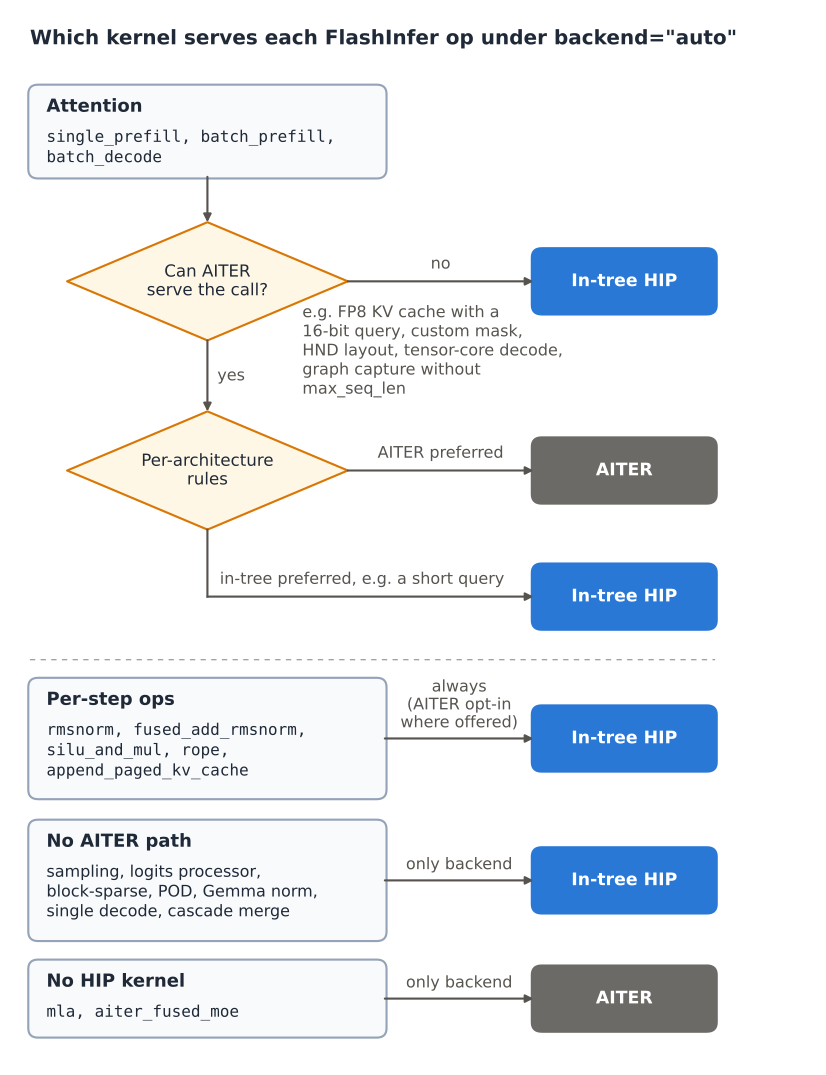
For the attention ops, auto first checks that AITER can serve the call at all (dtypes, KV layout, masks, and head dimensions), and then applies per-architecture routing rules measured on both gfx942 and gfx950. The rules live in one table, flashinfer/rocm/arch_caps.py, from which the repository’s support matrix is generated. After plan(), the batch prefill and batch decode wrappers report the choice in wrapper.backend ("aiter", or "fa2" for the in-tree kernel) and, for most AITER declines, the reason in wrapper.backend_fallback_reason.
AITER is integrated at the C++ level. When a call runs on AITER, FlashInfer launches the kernel from its own C++ code, either by loading AITER’s compiled attention kernels directly or by linking AITER’s C++ entry points for MoE, norm, activation, RoPE and KV append, rather than through AITER’s Python API. AITER’s Python side is used only to build, locate or probe a kernel variant, at plan() or, for ops that have no plan(), on the first call; MLA is the one op that still runs AITER through Python.
Where the In-Tree HIP Kernels Run#
The in-tree kernels are not only a fallback for machines without AITER. As the figure shows, they serve the root mean square normalization (RMSNorm), activation, RoPE, KV-append, and sampling calls a model makes by default, and the attention calls AITER cannot serve, including an FP8 KV cache read by a 16-bit query, and batch decode with use_tensor_cores=True, which speculative-decode verify uses. These kernels are optimized for CDNA3 and CDNA4 in their own right rather than carried over unchanged from the CUDA sources. The RoPE kernels and the activation kernels for the sigmoid linear unit (SiLU) and Gaussian error linear unit (GELU) were retuned on CDNA3 (MI300X), and the norm and prefill kernels size their shared-memory use from the local data share (LDS) capacity of the GPU they run on, which is larger on CDNA4. The example below shows the kind of work involved.
Example: Transposing V in One CDNA4 Instruction#
The in-tree prefill kernel is a FlashAttention-2 design built on the matrix fused multiply-add (MFMA) instructions of CDNA. Each tile does two matrix multiplies: Q·Kᵀ for the attention scores, then P·V to apply them. K fragments are read from LDS, the on-chip shared memory, in the layout the MFMA expects, but V is needed in the other orientation. So on CDNA3 the kernel loads each V fragment and then transposes it in registers with six cross-lane permutes (ds_bpermute_b32) before it feeds the P·V MFMAs.
CDNA4 adds a transposing LDS read, ds_read_b64_tr_b16 (__builtin_amdgcn_ds_read_tr16_b64_v4f16 in HIP), which returns the fragment already transposed in one instruction, replacing both the load and the shuffles.
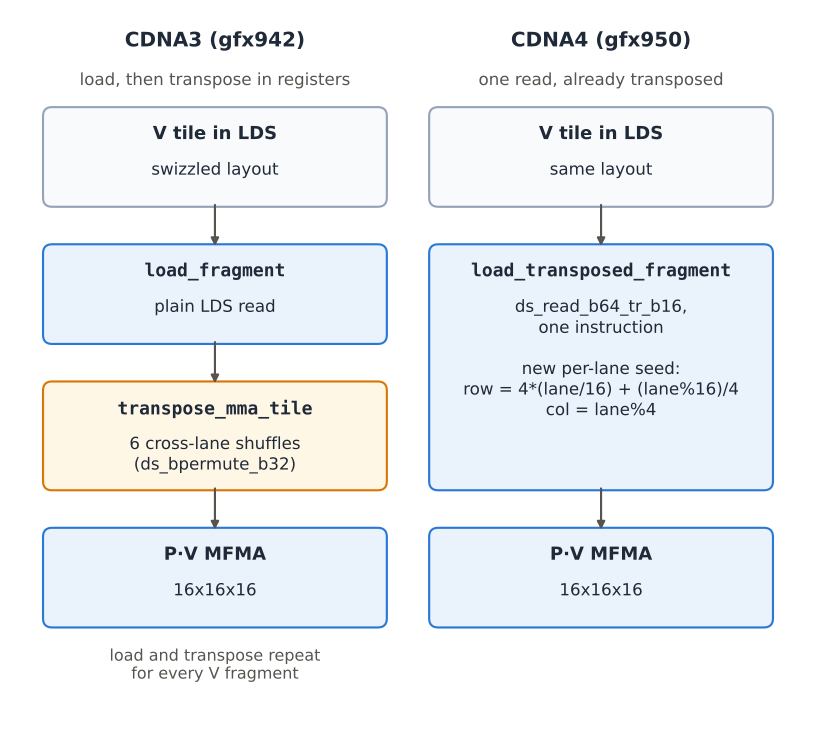
It is not a drop-in replacement. Within each 16-lane group the instruction distributes data differently from the software path: seeded at the old address, lane 0 receives the plausible but incorrect elements {0, 64, 128, 192} instead of {0, 16, 32, 48}. Solving for the seed that produces the required fragment gives a new index into the same swizzled LDS tile, so the shared-memory layout does not change (col counts 64-bit units of four 16-bit elements):
row = 4 * (lane / 16) + (lane % 16) / 4
col = lane % 4
Running Under torch.compile#
Set FLASHINFER_USE_TORCH_CUSTOM_OPS=1 before importing flashinfer, and the attention, KV-append and fused MoE ops in the torch-compile.md table compile under torch.compile; keep plan() outside the compiled region, and set the flag only for compiled runs, since it adds host-side dispatch to every eager call. PyTorch 2.12 can silently miscompile an op that writes into a view of a larger tensor, so pass append_paged_kv_cache separately allocated K and V caches rather than one [pages, 2, ...] cache. The document covers the other layouts to avoid and what compiles with fullgraph=True.
Support Matrix#
The table summarizes what runs on both architectures; the support matrix in the repository README lists every op with its backends, per architecture.
Area |
What runs on gfx942 and gfx950 |
|---|---|
Prefill attention |
Single, batch paged, batch ragged; multi-head attention (MHA), grouped-query attention (GQA), and multi-query attention (MQA); sliding window; logits soft-cap; custom masks (in-tree); FP8 KV cache |
Decode attention |
Single and batch paged; FP8 KV cache; CUDA graph capture; speculative-decode verify (chain drafts) |
Other attention |
Cascade (shared prefix), POD, block-sparse, MLA (DeepSeek V2/V3 layout) |
Fused ops |
RoPE (Llama and Llama 3.1 scaling, fused RoPE + FP8 quant + paged-KV append), RMSNorm and fused add-RMSNorm, Gemma RMSNorm, SiLU-and-mul and GELU-and-mul |
MoE |
|
Sampling |
Top-K, Top-P, Min-P, sampling from logits, the composable logits-processor pipeline |
FP8 KV caches on the in-tree kernels use the FNUZ encodings (float8_e4m3fnuz, float8_e5m2fnuz) on both architectures; the OCP float8_e4m3fn and float8_e5m2 are refused, because the in-tree kernels would read them under the FNUZ encoding and return silently wrong values: half-scale, and NaN for negative zero. The AITER FP8 paths, an FP8 query and KV cache on batch paged prefill and FP8 MoE weights, instead take the GPU’s own encoding, float8_e4m3fnuz on gfx942 and float8_e4m3fn on gfx950.
On gfx950, a float8_e4m3fn KV cache written for AITER FP8 prefill cannot also be read by decode. The in-tree decode refuses the OCP encoding, and AITER decode takes only 16-bit KV caches.
Upstream v0.6.18 is larger. What is absent splits by cause. Not supported on ROCm are modules that wrap a CUDA-only library, PTX, an SM-gated kernel, or CuTe DSL, so a ROCm equivalent is a rewrite rather than a port (for example flashinfer.gemm, the upstream CUTLASS fused_moe, flashinfer.cudnn, flashinfer.xqa). Where the import would already break, it is gated with a clear ImportError; otherwise the module imports and the call fails, so probe the symbol you need rather than trusting a successful import. Without a ROCm implementation are ordinary kernels that use none of those (for example flashinfer.topk, flashinfer.mamba’s selective state update). Separately, flashinfer.norm.layernorm and the quantized norm ops (layernorm_quant, rmsnorm_quant, fused_add_rmsnorm_quant) import but fail when called: their source builds, but the ROCm norm binding does not export them. The repository README and backend notes have the complete lists.
Getting Started#
FlashInfer on ROCm is built from source in the configuration in the table below.
Supported Configuration#
One software configuration is supported: the one the repository’s docker/Dockerfile.rocm builds.
Supported |
|
|---|---|
GPUs |
gfx942 (CDNA3: MI300X, MI325X), gfx950 (CDNA4: MI350X, MI355X) |
ROCm |
10.1.0 |
PyTorch |
2.12.0 |
Python |
3.12 |
OS |
Ubuntu 24.04 |
AITER |
|
No wheel or prebuilt image is published for this release; FlashInfer on ROCm is built from the repository. The development image pins a matched ROCm, PyTorch, Python and AITER set, so it is the shortest path to a working environment. Most of the image build is spent compiling AITER kernels ahead of time. The build refuses USER_UID=0 (root) or a UID another account in the image still holds (the base image’s ubuntu user at 1000 is removed first), so build the image as a regular user:
git clone --branch release/0.6.18+amd.2 https://github.com/AMD-Ecosystem/flashinfer.git
cd flashinfer
docker build -t flashinfer-dev:rocm10.1.0 -f docker/Dockerfile.rocm . \
  --build-arg USERNAME=$USER --build-arg USER_UID=$(id -u) \
  --build-arg USER_GID=$(id -g)
docker run -it --privileged --network=host --device=/dev/kfd --device=/dev/dri \
  --group-add video --group-add "$(getent group render | cut -d: -f3)" \
  --cap-add=SYS_PTRACE --security-opt seccomp=unconfined --shm-size=64G \
  -v "$PWD":/workspace -w /workspace flashinfer-dev:rocm10.1.0
Inside the container:
python -m pip install --no-build-isolation -ve .
python -c "import flashinfer; print(flashinfer.__version__)"
In-tree kernels compile just in time on first use. The image compiles every AITER prefill variant ahead of time, but AITER batch decode compiles at plan(), and AITER fused MoE and the opt-in AITER ops build on first use, so plan() or the first call can take several minutes while the kernels compile.
The repository README covers the test suite, the benchmark runner and the environment variables.
Example: Serving a Batch of Chat Requests#
An inference server’s model runner is where the FlashInfer calls come together. Requests arrive with prompts of different lengths; the server batches them, runs one prefill over every prompt token to fill the KV cache, and then generates with a decode loop, one new token per request per step. The example below is that loop for a Llama-3.1-8B-shaped model. To run quickly on one GPU it keeps two of the 32 layers and uses random weights, so the shapes and the sequence of calls are the real model’s, while the generated tokens are not meaningful. The five code blocks run in order as one script. Each layer keeps K and V in one tensor, which is fine in eager mode; under torch.compile they would need separate allocations.
No call passes backend=. Attention routes to AITER, while RMSNorm, RoPE, KV append, SiLU-and-mul and sampling run on the in-tree HIP kernels, as in the routing figure above.
1. The Model and Its Paged KV Cache#
The shapes are those of Llama 3.1 8B: 32 query heads sharing 8 KV heads of dimension 128, a 14,336-wide MLP and a 128,256-token vocabulary. The KV cache is paged, 16 tokens per page, with one tensor per layer, and each request owns enough pages for its prompt plus the tokens it will generate.
import torch
import flashinfer

# 4 chat requests on a Llama-3.1-8B-shaped model (2 of 32 layers, random weights).
torch.manual_seed(0)
dev, dt = "cuda", torch.bfloat16
hidden, inter, vocab, n_layers = 4096, 14336, 128256, 2
n_q, n_kv, hd = 32, 8, 128
page_size, new_tokens = 16, 32
prompt_lens = torch.tensor([300, 1200, 640, 2048], dtype=torch.int32)
batch = len(prompt_lens)

def weight(rows, cols):
    return torch.randn(rows, cols, dtype=dt, device=dev) / cols**0.5

ones = torch.ones(hidden, dtype=dt, device=dev)
embed, lm_head = weight(vocab, hidden), weight(vocab, hidden)
layers = [dict(qkv=weight((n_q + 2 * n_kv) * hd, hidden), o=weight(hidden, n_q * hd),
               gate_up=weight(2 * inter, hidden), down=weight(hidden, inter))
          for _ in range(n_layers)]

# Paged KV cache, one tensor per layer: each request owns the pages it will need.
pages = (prompt_lens + new_tokens + page_size - 1) // page_size
first_page = torch.cumsum(pages, 0) - pages
kv_caches = [torch.zeros(int(pages.sum()), 2, page_size, n_kv, hd, dtype=dt, device=dev)
             for _ in range(n_layers)]
2. Paged-KV Bookkeeping#
The paged APIs describe the cache with three index tensors: where each request’s pages start in a flat page list, the page IDs themselves, and how full each request’s last page is. kv_layout() derives them from each request’s current length, and is called again every step as the sequences grow.
def kv_layout(seq_lens):
    """indptr / indices / last_page_len for the pages in use at these lengths."""
    used = (seq_lens + page_size - 1) // page_size
    indptr = torch.cat([torch.zeros(1, dtype=torch.int32), torch.cumsum(used, 0)])
    indices = torch.cat([torch.arange(f, f + u) for f, u in zip(first_page.tolist(), used.tolist())])
    last = (seq_lens - 1) % page_size + 1
    return [t.to(dev, torch.int32) for t in (indptr, indices, last)]
3. One Forward Pass#
One function serves both phases. It takes the new tokens of every request packed together, plus an attention wrapper that has already been planned. get_batch_indices_positions() gives each new token its request and position, which RoPE and the KV append both need, and from the second norm on, fused_add_rmsnorm folds the residual add into the norm.
def forward(tokens, qo_indptr, seq_lens, layout, attn):
    """All requests' new tokens, packed: [num_tokens] -> last-token logits per request."""
    kv_indptr, kv_indices, kv_last = layout
    batch_idx, pos = flashinfer.get_batch_indices_positions(
        qo_indptr, seq_lens.to(dev), tokens.numel())
    x, residual = embed[tokens], None
    for L, cache in zip(layers, kv_caches):
        if residual is None:
            residual, x = x, flashinfer.rmsnorm(x, ones)
        else:
            flashinfer.fused_add_rmsnorm(x, residual, ones)  # residual += x; x = norm(residual)
        q, k, v = (x @ L["qkv"].T).split([n_q * hd, n_kv * hd, n_kv * hd], dim=-1)
        q, k, v = (t.reshape(-1, h, hd).contiguous() for t, h in ((q, n_q), (k, n_kv), (v, n_kv)))
        flashinfer.apply_llama31_rope_pos_ids_inplace(q, k, pos)
        flashinfer.append_paged_kv_cache(k, v, batch_idx, pos, cache,
                                         kv_indices, kv_indptr, kv_last)
        x = attn.run(q, cache).reshape(-1, n_q * hd) @ L["o"].T
        flashinfer.fused_add_rmsnorm(x, residual, ones)
        x = flashinfer.silu_and_mul(x @ L["gate_up"].T) @ L["down"].T
    flashinfer.fused_add_rmsnorm(x, residual, ones)
    return x[qo_indptr[1:] - 1] @ lm_head.T

def sample(logits):
    return flashinfer.sampling.top_k_top_p_sampling_from_logits(logits, top_k=50, top_p=0.9)
4. Prefill#
Prefill runs every prompt token of every request through one causal attention call, writes their K and V into the cache, and samples each request’s first output token from its last prompt position.
workspace = torch.zeros(256 * 1024 * 1024, dtype=torch.uint8, device=dev)

# Prefill: every prompt token of every request in one batched, causal call.
seq_lens = prompt_lens.clone()
qo_indptr = torch.cat([torch.zeros(1, dtype=torch.int32), torch.cumsum(prompt_lens, 0)]).int().to(dev)
layout = kv_layout(seq_lens)
prefill = flashinfer.BatchPrefillWithPagedKVCacheWrapper(workspace, "NHD")
prefill.plan(qo_indptr, *layout, n_q, n_kv, hd, page_size, causal=True, q_data_type=dt)
prompts = torch.randint(0, vocab, (int(prompt_lens.sum()),), device=dev)
next_tokens = sample(forward(prompts, qo_indptr, seq_lens, layout, prefill))
5. Decode Loop#
Decode generates one token per request per step. plan() runs once per step and every layer reuses it; run() is the per-layer call.
# Decode: one token per request per step; plan() once per step, shared by all layers.
decode = flashinfer.BatchDecodeWithPagedKVCacheWrapper(workspace, "NHD")
one_each = torch.arange(batch + 1, dtype=torch.int32, device=dev)
generated = [next_tokens]
for _ in range(new_tokens - 1):
    seq_lens += 1
    layout = kv_layout(seq_lens)
    decode.plan(*layout, n_q, n_kv, hd, page_size, q_data_type=dt)
    next_tokens = sample(forward(next_tokens, one_each, seq_lens, layout, decode))
    generated.append(next_tokens)

print(f"prefill ran on {prefill.backend}, decode on {decode.backend}")
print("generated token ids:", tuple(torch.stack(generated, 1).shape))  # (batch, new_tokens)
The first run compiles the kernels the image did not build ahead of time; later runs in the same container reuse them. On an MI355X it prints prefill ran on aiter, decode on aiter and generated token ids: (4, 32).
Summary#
In this blog, you learned how FlashInfer on ROCm brings the upstream v0.6.18 API to ROCm 10.1.0 on AMD Instinct CDNA3 and CDNA4 GPUs, how backend="auto" routes each call between the in-tree HIP kernels and AITER, and how to build it and run a serving loop on it. The main points:
The FlashInfer API on AMD: the decode, prefill, and MLA wrappers keep the upstream signatures.
backend="auto"routing: each call goes to the in-tree HIP kernels or to AITER by compatibility and by per-architecture rules, and the wrapper reports which one it chose. RMSNorm, activations, RoPE, KV append and sampling run on the in-tree kernels by default.FP8 and
torch.compile: FP8 KV caches and FP8 prefill are supported, and the ops in the table of the repository’storch-compile.mdcompile undertorch.compilewithFLASHINFER_USE_TORCH_CUSTOM_OPS=1.
Acknowledgements#
The authors wish to acknowledge the AMD teams that supported this work, whose contributions were instrumental in enabling FlashInfer: Aditya Bhattacharji, Pankaj Gupta, Anisha Sankar, Amit Kumar, Ram Seenivasan, Eliot Li, Ian Dass, Kiran Thumma, Aakash Sudhanwa, Ehud Sharlin, Saad Rahim, Lucia Cao, Jacky Zhao, Zhen Han, Junhua (Richard) Hou, Carlus Huang, Hai Xiao, Wenbo Shao, Marco Grond, Sriranjani Ramasubramanian.
References#
[1] Ye, Z., et al. (2025). FlashInfer: Efficient and customizable attention engine for LLM inference serving. arXiv:2501.01005
[2] AMD CDNA 3 Architecture. AMD CDNA 3 architecture white paper
[3] AMD CDNA 4 Architecture. AMD CDNA 4 architecture white paper
[4] Pandey, S., et al. (2025). AITER: AI Tensor Engine for ROCm. AITER: AI Tensor Engine for ROCm
[5] Composable Kernel: programming model for performance-critical kernels for machine learning workloads on AMD GPUs. Composable Kernel documentation
Disclaimers#
The information presented in this document is for informational purposes only and may contain technical inaccuracies, omissions, and typographical errors. The information contained herein is subject to change and may be rendered inaccurate for many reasons, including but not limited to product and roadmap changes, component and motherboard version changes, new model and/or product releases, product differences between differing manufacturers, software changes, BIOS flashes, firmware upgrades, or the like. Any computer system has risks of security vulnerabilities that cannot be completely prevented or mitigated. AMD assumes no obligation to update or otherwise correct or revise this information. However, AMD reserves the right to revise this information and to make changes from time to time to the content hereof without obligation of AMD to notify any person of such revisions or changes. THIS INFORMATION IS PROVIDED ‘AS IS.” AMD MAKES NO REPRESENTATIONS OR WARRANTIES WITH RESPECT TO THE CONTENTS HEREOF AND ASSUMES NO RESPONSIBILITY FOR ANY INACCURACIES, ERRORS, OR OMISSIONS THAT MAY APPEAR IN THIS INFORMATION. AMD SPECIFICALLY DISCLAIMS ANY IMPLIED WARRANTIES OF NON-INFRINGEMENT, MERCHANTABILITY, OR FITNESS FOR ANY PARTICULAR PURPOSE. IN NO EVENT WILL AMD BE LIABLE TO ANY PERSON FOR ANY RELIANCE, DIRECT, INDIRECT, SPECIAL, OR OTHER CONSEQUENTIAL DAMAGES ARISING FROM THE USE OF ANY INFORMATION CONTAINED HEREIN, EVEN IF AMD IS EXPRESSLY ADVISED OF THE POSSIBILITY OF SUCH DAMAGES. AMD, the AMD Arrow logo, AMD Instinct, ROCm, and combinations thereof are trademarks of Advanced Micro Devices, Inc. Other product names used in this publication are for identification purposes only and may be trademarks of their respective companies. © 2026 Advanced Micro Devices, Inc. All rights reserved.
Third-party content is licensed to you directly by the third party that owns the content and is not licensed to you by AMD. ALL LINKED THIRD-PARTY CONTENT IS PROVIDED “AS IS” WITHOUT A WARRANTY OF ANY KIND. USE OF SUCH THIRD-PARTY CONTENT IS DONE AT YOUR SOLE DISCRETION AND UNDER NO CIRCUMSTANCES WILL AMD BE LIABLE TO YOU FOR ANY THIRD-PARTY CONTENT. YOU ASSUME ALL RISK AND ARE SOLELY RESPONSIBLE FOR ANY DAMAGES THAT MAY ARISE FROM YOUR USE OF THIRD-PARTY CONTENT.