SPIR-V on ROCm: A Portable IR for AMD GPUs#

ROCm has compiled GPU code ahead of time (AOT), once per target architecture, since its first release. CPU software shifted to runtime just-in-time (JIT) compilation in the 1990s — Java HotSpot, V8, LuaJIT, .NET RyuJIT, PyPy — once the matrix of target × workload × deployment became too large to enumerate at build time. With its adoption of SPIR-V, ROCm now brings the compile-once, specialize-on-device model to AMD GPUs.
This post covers what SPIR-V is, why AMD adopted it, the compilation model and its trade-offs, and a reproducible single-kernel HIP example with measurements on MI350X (CDNA4), spot-checked on RX 9070 XT (RDNA4). A FAQ and status section at the end cover common questions and what is shipping, in flight, and not yet solved.
A follow-up post will discuss a real-world SPIR-V deployment at scale: PyTorch.
The Problem: AOT-per-Target Does Not Scale#
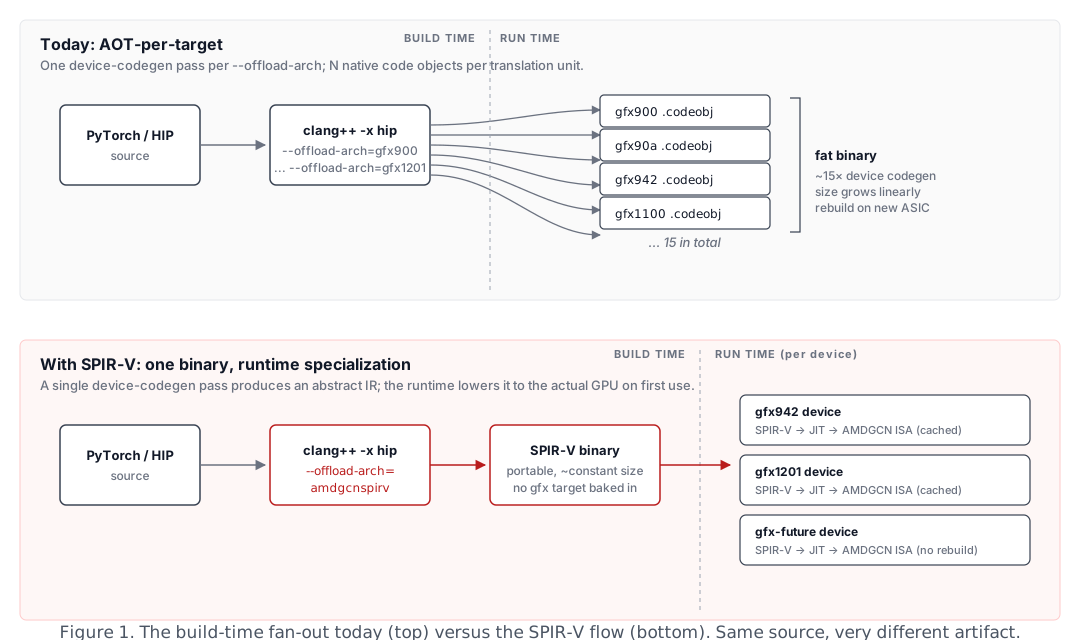
A ROCm application today is built by enumerating every GPU architecture
it needs to run on. For each entry, the device-side code of every HIP
translation unit is compiled once and the resulting code objects are
bundled into a fat binary. With N targets, that is N device code
objects per TU — a substantial multiplier on build time and on the
size of the shipped artifacts. Host code is compiled once. Beyond the
build system, developers themselves must be aware of every target: writing
per-arch #ifdef blocks, testing on each architecture, and updating those
lists whenever a new GPU ships.
An instance of this is PyTorch’s PYTORCH_ROCM_ARCH,
whose upstream default is currently fifteen targets spanning CDNA1/2/3
and RDNA2/3/4:
PYTORCH_ROCM_ARCH="gfx900;gfx906;gfx908;gfx90a;gfx942;gfx950;\
                   gfx1030;gfx1100;gfx1101;gfx1102;gfx1103;\
                   gfx1150;gfx1151;gfx1200;gfx1201"
Each entry expands into one --offload-arch=gfxXXX flag, and the
consequences cascade regardless of whether the build sits inside PyTorch,
a HIP application, or a downstream library:
Long build times. The device pipeline runs N times.
Large fat binaries. N native code objects per TU, all shipped together.
Build systems must enumerate every target. The framework has to maintain an explicit arch list and update it whenever a new GPU ships.
No forward compatibility. A binary built today cannot run on a GPU architecture that did not exist at build time — a new ASIC requires a new build.
This was tolerable when GPU architectures evolved on multi-year cycles. It strains under the current pace: new ASICs land frequently, cloud fleets mix generations, and frameworks ship precompiled artifacts that have to cover all of them.
The shift SPIR-V enables is from ahead-of-time compilation per target to compile once, just-in-time specialize on device. Figure 1 illustrates the difference.
What SPIR-V Is, and What AMD’s Flavor Adds#
SPIR-V — Standard Portable Intermediate Representation – V — is a binary, SSA-based IR defined by the Khronos Group. It originated as a portable IR for GPU programs (graphics shaders for Vulkan, compute kernels for OpenCL) and has since broadened into a standardized, toolchain-friendly IR that can be lowered to a vendor’s concrete ISA at a later stage. We treat SPIR-V here as an intermediate representation (IR), not a source language.
AMD’s AMDGCN-flavored SPIR-V carries vendor-specific constructs through two
mechanisms. Inline assembly is encoded via the SPV_INTEL_inline_assembly
extension, which wraps the raw assembly string in the SPIR-V binary. AMDGCN
intrinsics and target-specific builtins, by contrast, are handled transparently
by the compiler and translator pipeline: they are lowered to function
declarations and reverse-translated accordingly, with no extension required.
Together, these mechanisms preserve expressiveness that a strictly-portable IR
would lose.
This variant is exposed through the amdgcnspirv abstract target in
LLVM/Clang.
In ROCm, AMDGCN-flavored SPIR-V serves three roles:
A target-agnostic GPU IR that can be produced once.
A late-binding abstraction over AMD GPU architectures.
A way to decouple compilation from device-specific codegen.
How AMD Got SPIR-V into Upstream LLVM#
The amdgcnspirv target is not a fork. It is a multi-year effort, in
upstream LLVM, that incrementally turned generic SPIR-V into a usable
flavor of AMDGCN. The relevant pieces, listed in roughly the order
they were built because each layer depends on the one before it:
Target plumbing. A new Clang target
SPIRV64AMDGCNTargetInfo(clang/lib/Basic/Targets/SPIR.h), identified by the triplespirv64-amd-amdhsa--amdgcnspirv, that delegates feature/builtin decisions to the AMDGPU target rather than to vanilla SPIR-V. The driver side (clang/lib/Driver/ToolChains/HIPSPV.cpp) wires-x hip --offload-arch=amdgcnspirvinto the SPIR-V translation step and lets you mixamdgcnspirvwith concretegfxXXXtargets in one invocation.ABI alignment with AMDGPU, so that calling conventions, aggregate passing, address spaces, and
__builtin_va_listmatch what AMDGCN expects after lowering instead of what generic SPIR-V would default to. Without this step a SPIR-V binary lowered to AMDGCN at runtime would not be ABI-compatible with the host code that called it.Intrinsic surface. AMDGCN intrinsics (
__builtin_amdgcn_*) and inlineasm volatile(...)are reachable through the SPIR-V flow via the AMD extension; the in-tree backend’sSPIRVInlineAsmLoweringandSPIRVEmitIntrinsicscarry the AMDGPU-specific encodings through to the binary.Late-resolved feature predicates, the capstone — discussed in the next section.
This is a portable IR built from a target compiler, not a portable compiler retrofitted to a target. That distinction matters: every target-specific behavior the SPIR-V flavor preserves is one pull request (PR), with tests, in upstream LLVM.
Compilation Model#
LLVM IR is not target-agnostic — by the time it leaves the front end, the AST has already been typed against the chosen target. The portable artifact in this flow is the SPIR-V binary, not the IR. The full pipeline, with the build-time / run-time boundary made explicit, is shown in Figure 2:
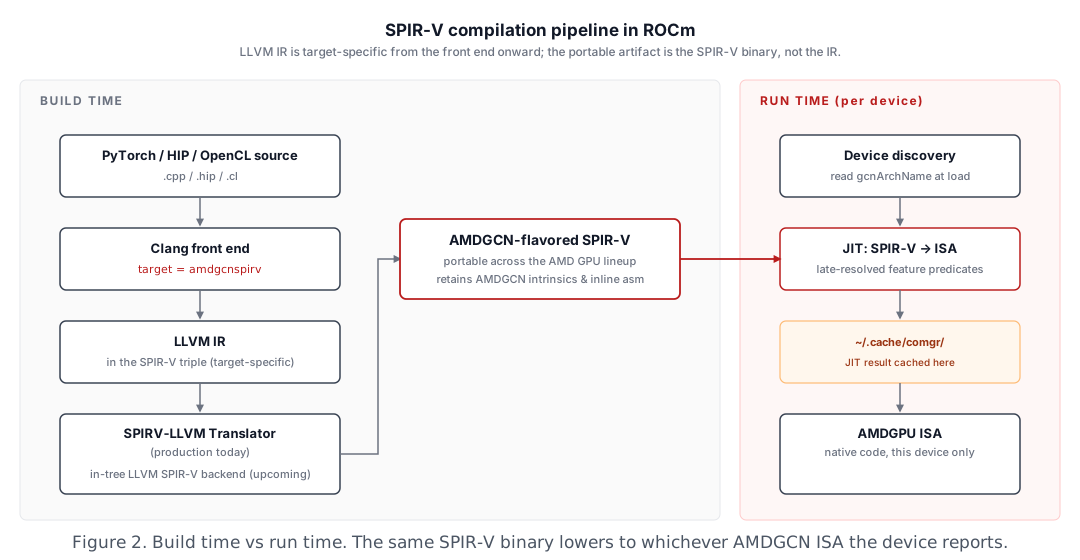
Today, the SPIRV-LLVM Translator performs the LLVM-IR → SPIR-V step. An in-tree LLVM SPIR-V backend is being hardened and is expected to become the default path.
Late-Resolved Feature Predicates (“ZCFS”)#
A design challenge with portable GPU IR is that hardware features vary
across GPU generations — and encoding those differences at compile time forces
an ugly tradeoff: add runtime guards that penalize every dispatch, or multiply
your build matrix to cover each architecture. AMD’s late-resolved feature
identifying predicates work — informally called ZCFS (Zero-Cost
Feature Selection), since it lets per-arch dispatch survive the trip
through a portable IR without paying any runtime cost — landed via
LLVM PR #134016 and makes this concern largely go away.
Predicates such as __builtin_amdgcn_processor_is
and __builtin_amdgcn_is_invocable are resolved during SPIR-V → native
lowering, so exactly one branch survives per arch and surrounding loops fold
to per-arch constants. The result is a single SPIR-V binary that lowers to a
different ISA for each GPU at JIT time, with no runtime overhead from the
dispatch itself. The interface is uniform: the same builtins
work whether the target is a concrete architecture like --offload-arch=gfx950
or the abstract --offload-arch=amdgcnspirv, so no source forking is needed.
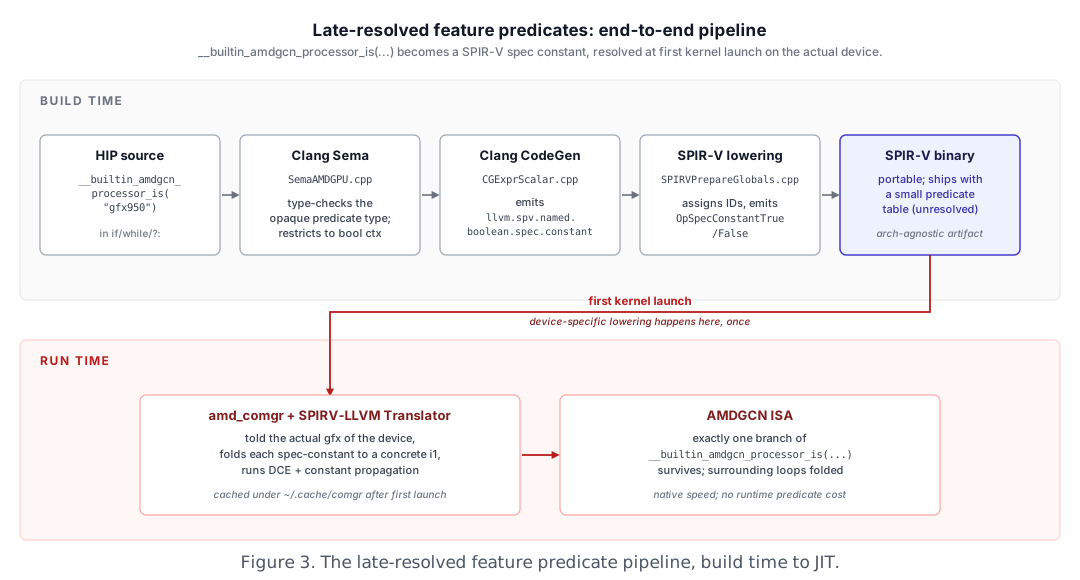
The mechanism, end-to-end, is worth understanding because it is the thing that makes portable AMD GPU IR not regress at runtime:
Sema (
clang/lib/Sema/SemaAMDGPU.cpp, +304 lines in PR #134016) constrains where__builtin_amdgcn_processor_isand__builtin_amdgcn_is_invocablemay appear — boolean control-flow contexts only — and gives them an opaque__amdgpu_feature_predicate_ttype (clang/include/clang/Basic/AMDGPUTypes.def) that cannot be stored, compared, or smuggled across function boundaries.CodeGen (
clang/lib/CodeGen/CGExprScalar.cpp) lowers the predicate tollvm.spv.named.boolean.spec.constant(i32 ID, metadata !"gfx942")for SPIR-V targets. The supporting intrinsic itself was added in LLVM PR #187420 (commitd8104bfc9e9d, 2026-03-20) so the larger ZCFS work in PR #134016 (commit18e695890306, 2026-03-30) had something to lower into.SPIR-V lowering (
llvm/lib/Target/SPIRV/SPIRVPrepareGlobals.cpp) assigns deterministic IDs to each unique predicate and emitsOpSpecConstantFalseper ID — deliberately, so that an unspecialized predicate defaults to false and the controlled block is removed. The binary now contains a small table of predicates, each unresolved.Runtime lowering (the SPIRV-LLVM Translator invoked under
amd_comgr) is told the actualgfxtarget of the device it is lowering for. It folds each spec-constant to a concretei1and then runs a dedicated predicate-resolution pass that folds only the chains rooted at predicates. This pass is deterministic, runs at all optimization levels including debug, and is a hard failure if any predicate chain cannot be fully resolved — guaranteeing that exactly one branch survives per arch in the emitted AMDGCN ISA.
Figure 3 shows the end-to-end pipeline.
The next section puts this mechanism into practice: the two builtins
that ride this lowering path — __builtin_amdgcn_processor_is and
__builtin_amdgcn_is_invocable — used in a realistic kernel that
reads as a runtime test but, after JIT, leaves exactly one branch
alive on each device.
Late-Resolved Predicates in Practice#
The compilation model section above introduced the mechanism — how predicates flow from Clang through SPIR-V to the runtime JIT. This section shows how to use them. Two builtins were introduced by LLVM PR #134016; both are folded during SPIR-V → AMDGCN lowering, so exactly one branch survives in the emitted native code and the dispatch costs nothing at runtime.
__builtin_amdgcn_processor_is("gfxXXX")— asks “is the device this is being lowered to a specific arch?” Use it when the right answer truly varies per ASIC generation (e.g., a per-arch tuning constant).__builtin_amdgcn_is_invocable(builtin)— asks “is this specific builtin callable on the target device’s ISA?” Use it when the question is really “does this hardware capability exist?”; it survives ASIC additions and removals without a rewrite, where the processor-is check would need updating every time the supporting list changes.
A realistic kernel picks the best implementation the device offers
and falls back gracefully when nothing better is available. AMD’s
matrix accelerators come in two families — MFMA (matrix fused
multiply-add) on CDNA and WMMA on RDNA — and the two predicates
compose naturally for this dispatch: __builtin_amdgcn_is_invocable
selects the family (MFMA? WMMA? neither?), and
__builtin_amdgcn_processor_is narrows within a family when a
newer ASIC adds a wider tile shape.
// One SPIR-V binary; one kernel; three paths. At JIT time exactly
// one of these branches survives in the native code emitted for the
// device. Adding a brand-new ASIC later requires no rebuild: the
// kernel will pick the first capability it finds at JIT.
__global__ void mma_kernel_16x16(const float* A, const float* B, float* C) {
    if (__builtin_amdgcn_is_invocable(__builtin_amdgcn_mfma_f32_16x16x4f32)) {
        // CDNA — matrix accelerator (MFMA family).
        if (__builtin_amdgcn_processor_is("gfx950")) {
            // CDNA4 adds wider MFMA tiles; use them when present.
            do_mma_mfma_wide(A, B, C);
        } else {
            // CDNA1/2/3 — baseline 16x16x4 fp32 MFMA.
            do_mma_mfma(A, B, C);
        }
    } else if (__builtin_amdgcn_is_invocable(
                   __builtin_amdgcn_wmma_f32_16x16x16_f16)) {
        // RDNA3+ — matrix accelerator (WMMA family).
        do_mma_wmma(A, B, C);
    } else {
        // No matrix accelerator on this device. Works on any AMDGCN,
        // including older RDNA — the universal fallback.
        do_mma_scalar(A, B, C);
    }
}
What each device sees after JIT:
MI300 / MI350 (CDNA3 / CDNA4) — only the corresponding MFMA branch survives. Even the outer
is_invocabletest onmfma_f32_16x16x4f32is folded to a literaltrue; the innerprocessor_is("gfx950")is folded totrueon CDNA4 andfalseon CDNA3.RX 9070 XT (RDNA4) / RX 7900 (RDNA3) — only the WMMA branch survives; the MFMA branch and its inner test are gone.
Anything older — only
do_mma_scalarsurvives.
This is what lets a single SPIR-V wheel ship for all of AMD — today and across GPU generations not yet announced:
Forward-compatible. A binary built today will run on a GPU that ships next year. The runtime JITs it to whatever ISA the device reports; if that future ASIC introduces a new matrix family, adding it costs one branch in the
is_invocablechain and none of the existing branches are touched.Backward-compatible. Older parts with no matrix unit at all still execute correctly via the scalar fallback.
What You Get#
Property |
SPIR-V flow |
AOT-per-target flow |
|---|---|---|
Binary count |
1 portable binary |
1 per |
Forward compatibility |
Runs on GPUs released after build |
Requires rebuild for new ISAs |
Fat-binary size |
Flat — see scaling section |
Grows ~linearly with target count |
Build time |
Single device-codegen pass per TU |
N device-codegen passes per TU |
Framework awareness of HW |
Minimal |
Build system enumerates targets |
Per-arch dispatch (in-kernel) |
Late-resolved at JIT, no runtime cost |
Compile-time |
The forward-compatibility point is worth making concrete: a SPIR-V binary built today targets GPUs that did not exist when it was built. The runtime lowers it to the new ISA the first time the kernel runs.
What It Costs#
Two real costs that show up on any SPIR-V build, regardless of which framework or application is hosting it:
First-launch JIT latency. SPIR-V → native lowering happens on the first kernel invocation on a given device. In the single-kernel benchmark below this adds roughly 70–100 ms. At framework scale the cost grows to seconds per first-touched kernel (numbers in a follow-up post). The cost is paid once per (TU, device) pair and then cached. The per-process JIT cache in
~/.cache/comgr/already mitigates this today: the cost is paid once per cache lifecycle. A planned further step is JIT-at-package-install — trading install time for zero startup latency, akin to shader pre-compilation in modern games.Code that assumed compile-time arch macros has to be ported. Patterns like
#if defined(__gfx942__)need to move to runtime predicates (__builtin_amdgcn_processor_is). With ZCFS-style late-resolved predicates this rewrite has no runtime overhead, but it is non-trivial work in places.
A third cost is framework-specific: library coverage. ROCm’s per-arch device libraries do not yet all ship SPIR-V variants, so a SPIR-V application is bounded by its least-portable dependency. The current state is covered in Where things stand and what is next below.
With What you get and What it costs laid out conceptually, the next section lets you measure both for yourself — a reproducible single-kernel benchmark covering build time, binary size, runtime, and a scalability comparison across target counts, on MI350X and spot-checked on RX 9070 XT.
Quick Start#
This section gets a SPIR-V binary in hand and confirms it produces
the same output as a per-gfx build. The deep dive that follows
measures both: compile time, binary size, first-launch JIT cost, and
scaling across target counts.
Bundled with this post. A small set of files in the src/
directory is everything you need to reproduce the numbers below:
Sources:
custom_kernel_spirv.hip— the SPIR-V variant (full source insrc/custom_kernel_spirv.hip).custom_kernel_standard.hip— the per-gfxbaseline, identical except for one helper (shown in step 2).
Prerequisites#
ROCm 7.2 or later. All measurements in this post were captured inside the
rocm/dev-ubuntu-24.04:7.2.3container.A supported AMD GPU. All benchmark numbers use three compile modes — compiler default,
-O3, and-O3+--offload-compress— viaBUILD_MODE(see FAQ).A Linux environment with Docker.
Start the container with GPU access:
docker run -it --rm --device=/dev/kfd --device=/dev/dri \
    --group-add video -w /workspace \
    rocm/dev-ubuntu-24.04:7.2.3
Verify ROCm is visible inside the container:
rocminfo | grep gfx | head -1
On a MI350 Series (MI350X/MI355X) node, you should see:
Name: gfx950
The ROCm LLVM toolchain (clang++, llvm-objdump) lives in
/opt/rocm/llvm/bin. Put it on PATH before running the commands
below:
export PATH=/opt/rocm/llvm/bin:$PATH
1. Build a SPIR-V Binary#
Use the abstract amdgcnspirv target to generate AMDGCN-flavored SPIR-V:
clang++ -x hip --offload-arch=amdgcnspirv \
    -O3 custom_kernel_spirv.hip -o vecadd_spirv
You can confirm no concrete target is embedded:
llvm-objdump --offloading ./vecadd_spirv
# vecadd_spirv:   file format elf64-x86-64
# Extracting offload bundle: vecadd_spirv.0.host-x86_64-unknown-linux-gnu-
# Extracting offload bundle: vecadd_spirv.0.hip-spirv64-amd-amdhsa--amdgcnspirv
2. Build a Per-gfx Baseline#
The src/ directory already includes custom_kernel_standard.hip.
Build it targeting concrete GPUs (here the two CDNA datacenter parts
gfx942 and gfx950):
clang++ -x hip --offload-arch=gfx942,gfx950 \
    -O3 custom_kernel_standard.hip -o vecadd_fat
In contrast to step 1, the fat binary embeds one native bundle per
concrete gfx target you asked for:
llvm-objdump --offloading ./vecadd_fat
#vecadd_fat:     file format elf64-x86-64
#Extracting offload bundle: vecadd_fat.0.host-x86_64-unknown-linux-gnu-
#Extracting offload bundle: vecadd_fat.0.hipv4-amdgcn-amd-amdhsa--gfx942
#Extracting offload bundle: vecadd_fat.0.hipv4-amdgcn-amd-amdhsa--gfx950
The two source files are deliberately a minimal diff: same kernel,
same launches, same host logic. The only substantive difference is
how items_per_thread_for_arch() expresses the per-arch dispatch —
compile-time #if macros in the standard version, resolved per
--offload-arch device-codegen pass at build time:
__device__ __forceinline__ int items_per_thread_for_arch() {
#if defined(__gfx942__)
    return 4;  // CDNA3
#elif defined(__gfx950__)
    return 4;  // CDNA4
#elif defined(__gfx90a__)
    return 4;  // CDNA2
#elif defined(__gfx1201__)
    return 2;  // RDNA4
#elif defined(__gfx1100__)
    return 2;  // RDNA3
#else
    return 1;
#endif
}
In custom_kernel_spirv.hip it uses __builtin_amdgcn_processor_is(),
resolved during SPIR-V → native lowering at JIT time:
__device__ __forceinline__ int items_per_thread_for_arch() {
    if (__builtin_amdgcn_processor_is("gfx942"))  return 4;  // CDNA3
    if (__builtin_amdgcn_processor_is("gfx950"))  return 4;  // CDNA4
    if (__builtin_amdgcn_processor_is("gfx90a"))  return 4;  // CDNA2
    if (__builtin_amdgcn_processor_is("gfx1201")) return 2;  // RDNA4
    if (__builtin_amdgcn_processor_is("gfx1100")) return 2;  // RDNA3
    return 1;
}
Different binding time, same end result — and that one-function diff is
exactly what the benchmark numbers below are measuring. (The two
builtin predicates used here — __builtin_amdgcn_processor_is and
__builtin_amdgcn_is_invocable — are covered in detail in the
Late-resolved predicates in practice
section above.)
3. Run Both, Validate Functional Equivalence#
./vecadd_spirv
Output:
=== SPIR-V HIP Vector Add (portable amdgcnspirv) ===
Binary is portable -- native code generated at runtime

Device: AMD Radeon Graphics (gfx950:sramecc+:xnack-)
Block size: 256, 4 items/thread, grid: 1024 (chosen on host from gcnArchName)

First launch (includes SPIR-V JIT compilation):
  Kernel time: 83.122 ms  (includes JIT overhead)
Second launch (native code cached):
  Kernel time: 0.010 ms  (native speed)

Result: PASS
Run the fat:
./vecadd_fat
Output:
=== Standard HIP Vector Add (per-gfx fat binary) ===
Binary embeds native code for its --offload-arch targets

Device: AMD Radeon Graphics (gfx950:sramecc+:xnack-)
Block size: 256, 4 items/thread, grid: 1024 (chosen on host from gcnArchName)

First launch (native code object from fat binary):
  Kernel time: 0.556 ms
Second launch:
  Kernel time: 0.007 ms  (native speed)

Result: PASS
Both printed Result: PASS, and displayed the first launch and second launch timing.
4. Verify Portability on a Different GPU (e.g., gfx1201)#
This step verifies the portability claim directly: vecadd_spirv
still runs on a GPU that wasn’t in the build, while vecadd_fat
fails because its native bundles only target gfx942/gfx950.
Copy both binaries to a non-CDNA system — we used a Radeon RX 9070
XT (gfx1201) — and start the same container as in Prerequisites
(rocm/dev-ubuntu-24.04:7.2.3).
Verify ROCm sees the RDNA4 GPU inside the container:
rocminfo | grep gfx | head -1
# Name:                    gfx1201
Run the SPIR-V binary:
./vecadd_spirv
=== SPIR-V HIP Vector Add (portable amdgcnspirv) ===
Binary is portable -- native code generated at runtime

Device: AMD Radeon RX 9070 XT (gfx1201)
Block size: 128, 2 items/thread, grid: 4096 (chosen on host from gcnArchName)

First launch (includes SPIR-V JIT compilation):
  Kernel time: 67.528 ms  (includes JIT overhead)
Second launch (native code cached):
  Kernel time: 0.020 ms  (native speed)

Result: PASS
The same binary that ran on MI350X (gfx950) now runs on RDNA4 — no rebuild, JIT lowering on first launch.
Now the fat binary:
./vecadd_fat
# Segmentation fault (core dumped)
The segfault is the surface symptom; the actual diagnostic comes from the HIP runtime log:
AMD_LOG_LEVEL=3 ./vecadd_fat
:3:hip_module.cpp           :825 : 836675924502 us:   hipLaunchKernel ( 0x200ba0, {4096,1,1}, {128,1,1}, 0x7ffcca7d9b20, 0, char array:<null> )
:3:hip_fatbin.cpp           :524 : 836675924584 us:  Forcing SPIRV: false
:1:hip_fatbin.cpp           :687 : 836675924592 us:  No compatible code objects found for: gfx1201, value of HIP_FORCE_SPIRV_CODEOBJECT: 0
No compatible code object for gfx1201 — the fat binary only
contains gfx942 and gfx950 bundles, so the runtime has nothing to
launch. The SPIR-V binary, by contrast, carries the portable IR and
JIT-lowers to whatever ISA rocminfo reports.
Deep Dive: Benchmarking SPIR-V vs Fat#
The lead measurement is on a CDNA4 datacenter part (gfx950,
MI350X), spot-checked on RDNA4. All numbers in this section come from
one pinned container image:
Component |
Version |
|---|---|
Container image |
|
OS |
Ubuntu 24.04.4 LTS |
ROCm |
7.2.3 |
Compiler |
AMD clang 22.0.0git ( |
GPU under test |
AMD Instinct MI350X ( |
Driver Scripts:
benchmark.sh— clears~/.cache/comgr/, rebuilds both binaries, and prints the per-arch comparison table. Takes optional[runs],GFX_TARGETS=…, andBUILD_MODE(default,O3,O3compress).run_singlekernel_scaling.sh— sweeps 1/2/4/8/15 native targets plusamdgcnspirv, median of 3 trials per row (honoursBUILD_MODE).run_all_build_modes.sh— runs both scripts for all threeBUILD_MODEvalues and writesartifacts/benchmark/results.csvplusartifacts/_singlekernel_scaling/data_{default,O3,O3compress}.csv.
Cold-Cache Methodology#
The runtime caches JIT output in ~/.cache/comgr/; without clearing
it, a SPIR-V “cold” run is actually warm. All three driver scripts
used below (benchmark.sh, run_singlekernel_scaling.sh, and the
run_all_build_modes.sh wrapper) clear ~/.cache/comgr/ and
/tmp/comgr-* before each run so cold-start numbers reflect real
first-launch JIT cost. Each builds the binaries, runs each N times,
and prints compile time / binary size / first-launch / averages; the
result tables below are pasted directly from their output.
Build Flags: Default vs -O3 vs -O3 + Compress#
(1) Single-target build-flag sweep. This is the first of three
measurements. It isolates the effect of the two compile flags —
-O3 and --offload-compress — at a single target (gfx950),
comparing fat against amdgcnspirv across the three BUILD_MODE
combinations exposed by the script (default, O3, O3compress).
BUILD_MODE selects the compile flags: default uses the compiler’s defaults (no explicit -O flag), O3 adds -O3, and O3compress adds -O3 --offload-compress.
Reproduce all three side by side:
./run_all_build_modes.sh
The table below shows binary size only — the clearest single dimension to demonstrate flag impact. Figure 4 adds compile time and steady-state runtime across the same three modes:
|
fat ( |
|
|---|---|---|
|
56,256 B |
44,864 B |
|
23,136 B |
44,200 B |
|
14,784 B |
19,304 B |
At default, SPIR-V can look smaller than single-target fat. At -O3, fat shrinks ~2.4× while
SPIR-V on-disk size is essentially unchanged. --offload-compress
shrinks both. Figure 4 shows all three dimensions side by side.
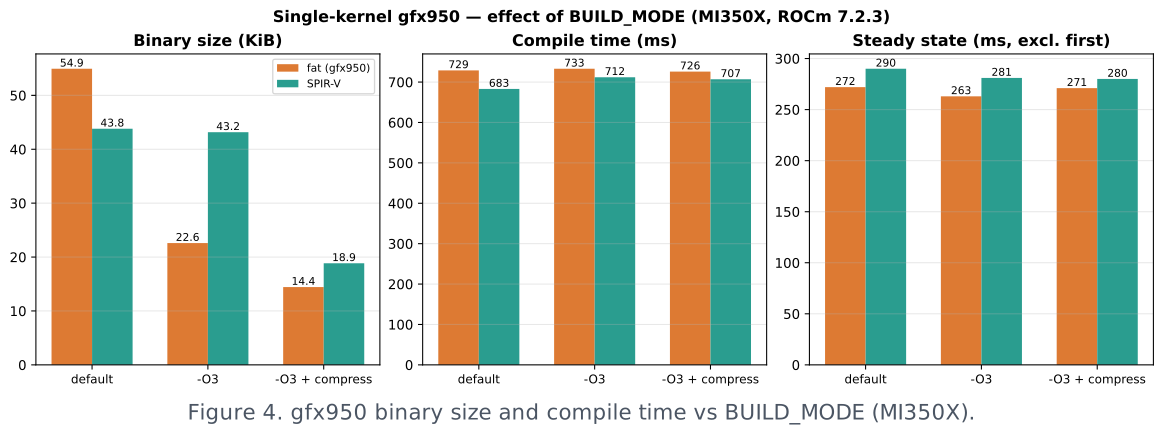
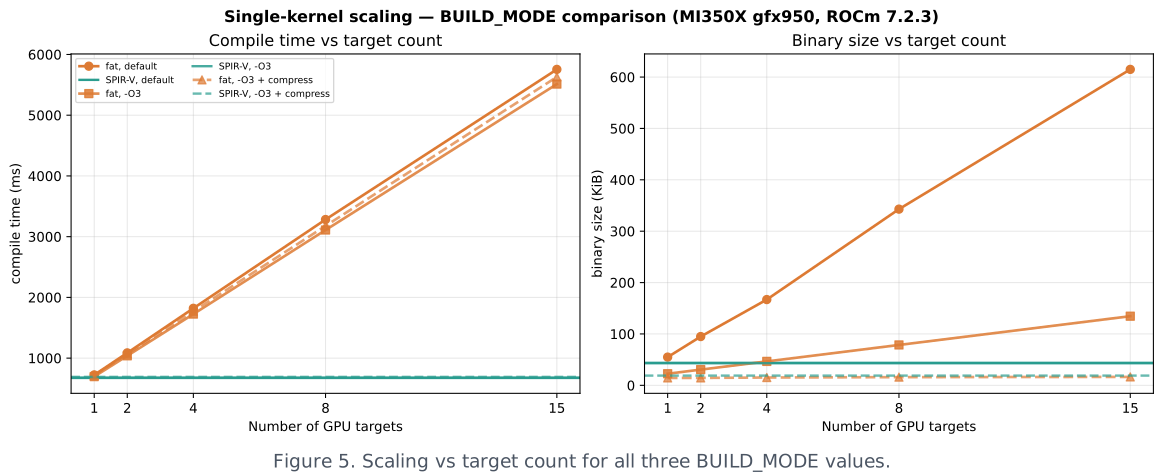
Figure 5 below is the output of run_singlekernel_scaling.sh run
across all three BUILD_MODE values. It sweeps fat builds from 1 to
15 targets (1, 2, 4, 8, 15) and compares each against amdgcnspirv
on both binary size and compile time — fat grows on both axes under
every flag setting, while SPIR-V stays flat.
Release Build (BUILD_MODE=O3) — Primary Comparison#
(2) Release build at 1 vs 2 targets. Pinning the build mode to
what frameworks actually ship (-O3), and stepping target count
from one to two, to show what happens to compile time, binary size,
and runtime as the arch list grows by one entry. benchmark.sh with
BUILD_MODE=O3 and GFX_TARGETS=…:
BUILD_MODE=O3 GFX_TARGETS=gfx950          ./benchmark.sh 5
BUILD_MODE=O3 GFX_TARGETS="gfx942 gfx950" ./benchmark.sh 5
5 runs each, cache cleared between:
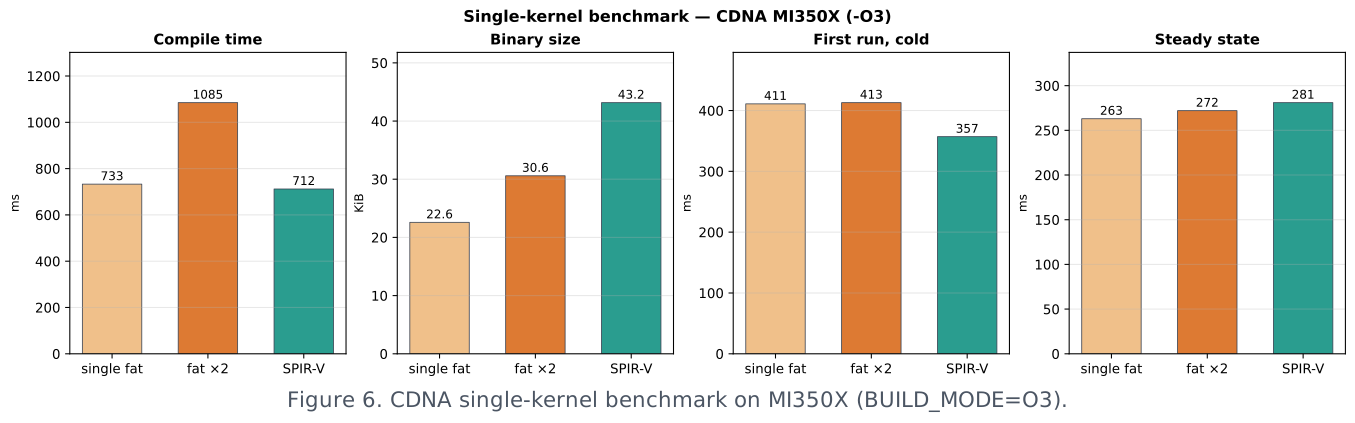
What to look for. At one or two targets, SPIR-V does not undercut fat on absolute size or compile time — a single-arch fat binary is actually smaller here. SPIR-V’s wins are flat scaling (no growth with target count) and forward compatibility (the same binary lowers to GPUs that did not exist at build time). The 15-target sweep below makes that shape visible.
fat ( |
fat ( |
|
|
|---|---|---|---|
Compile time |
733 ms |
1,085 ms |
712 ms |
Binary size |
23,136 B |
31,328 B |
44,200 B |
First run (cold) |
411 ms |
413 ms |
357 ms |
Avg (excl. first) |
263 ms |
272 ms |
281 ms |
Figure 6 visualizes these numbers.
Reading the numbers:
Compile time is flat for SPIR-V (~710 ms whether you ask for one arch or two) while the fat side scales: 733 ms for
gfx950alone, 1,085 ms oncegfx942is added. Every extragfxXXXadds another device-codegen pass.SPIR-V binary size is constant at 44,200 B regardless of arch count; the fat binary grows 23,136 → 31,328 B going from one target to two. On this kernel a single-target native build is actually smaller than the SPIR-V artifact — the win is flat size as the arch list grows, not a smaller baseline.
First-launch JIT overhead is small — ~74 ms above steady state here (351 ms first run vs 277 ms steady). Notably, fat-binary cold start (407–414 ms) is larger than SPIR-V’s (351 ms), because it is dominated by HIP runtime init rather than kernel codegen.
Steady state matches native within noise — 266–268 ms (fat) vs 277 ms (SPIR-V), a few percent that is inside run-to-run variance on this kernel.
These are uncompressed bundle sizes — --offload-compress shrinks
both sides without changing the shape (see the scaling table below).
Scaling to 15 Targets#
(3) Full scaling sweep. The release-build pattern from (2)
extended across the full target-count range — 1, 2, 4, 8, and 15
— to show that fat compile time and binary size grow with target
count while SPIR-V stays flat. run_singlekernel_scaling.sh does
this for amdgcnspirv (median of 3 trials). BUILD_MODE=O3 is
the release row used in Figure 6; default shows the
unoptimized fat growth that makes SPIR-V look smaller at one target.
Targets |
|
|
|
|---|---|---|---|
1 ( |
55.0 |
22.6 |
14.5 |
2 ( |
94.9 |
30.6 |
14.5 |
15 (full default) |
615.0 |
134.6 |
16.4 |
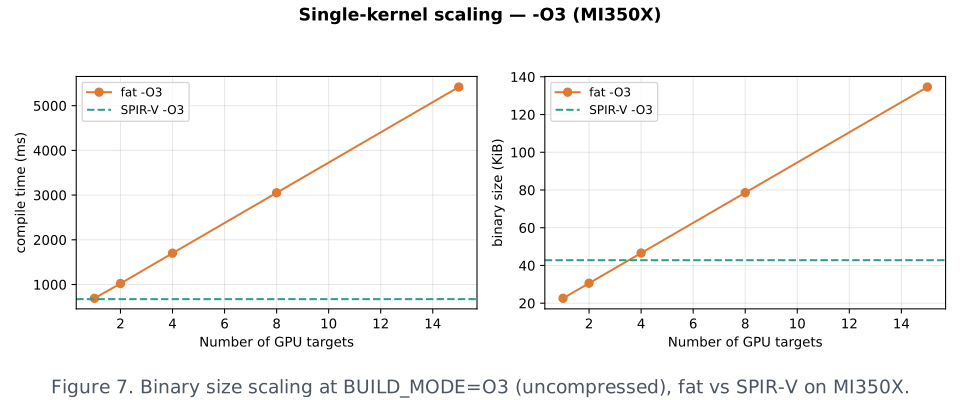
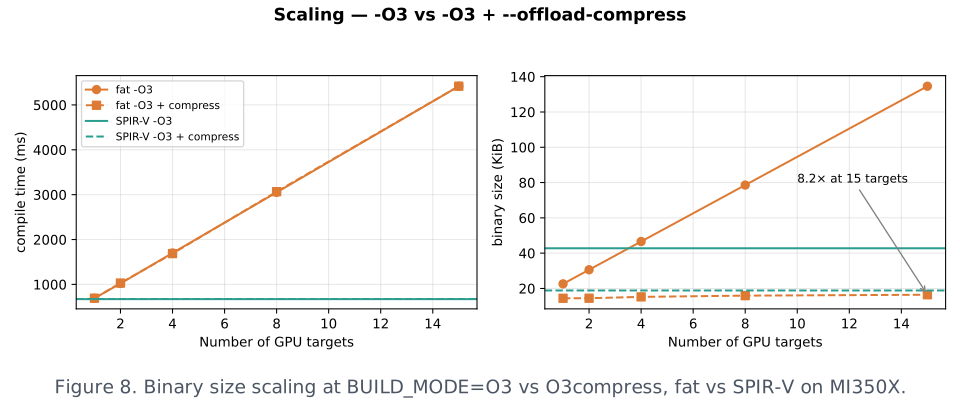
SPIR-V (n=0) is flat per mode: 43.7 KiB (default), 43.1 KiB (O3),
18.9 KiB (O3compress). Only the fat columns grow with target count.
Figures 7 and 8 visualize this scaling.
Three takeaways (release -O3 row):
Compile time scales linearly with arch count — ~340 ms per added
--offload-arch; SPIR-V stays ~678 ms.Binary size — fat grows 22.6 → 134.6 KiB (1 → 15 targets); SPIR-V stays ~43 KiB.
With
O3compress— fat-15 drops to 16.4 KiB (8.2× smaller than uncompressed fat-15); SPIR-V compresses to 18.9 KiB — the two converge. Compile-time flatness and forward compatibility remain the durable wins.
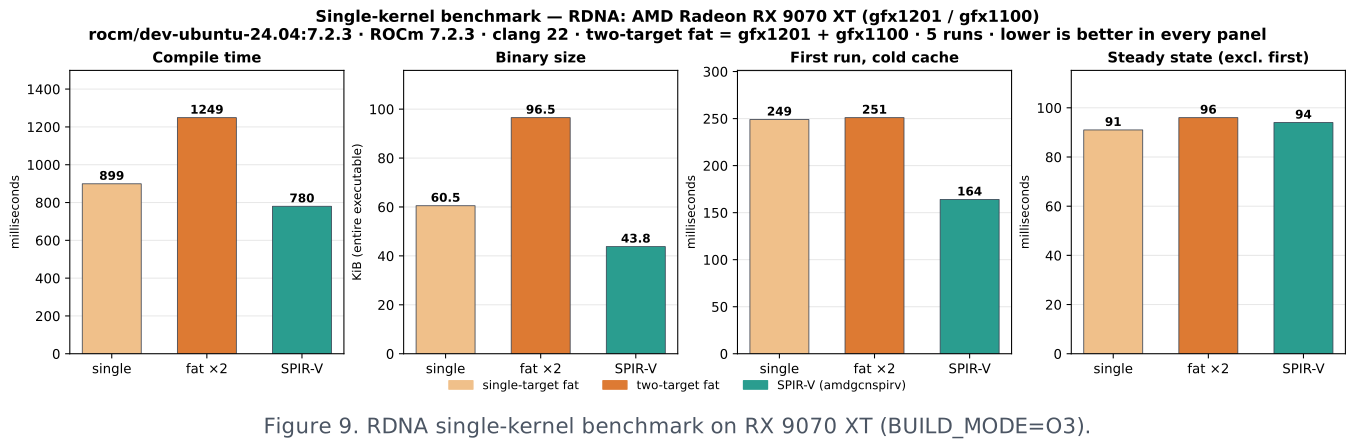
We spot-checked the same kernel and workflow on RX 9070 XT (RDNA4,
gfx1201); compile-time flatness, fat scaling with target count, and
steady-state parity with native matched the CDNA pattern, as shown in
Figure 9 below.
FAQ#
Q. How does -O3 affect the binary sizes in this post?
Very differently for fat and SPIR-V, because they ship different things.
A fat binary embeds finished native AMDGCN code objects — one per
--offload-arch. -O3 runs the full device optimization pipeline before
those objects are sealed (dead-code elimination, inlining, loop unrolling,
per-arch #ifdef collapse), so each native slice shrinks dramatically. On
the MI350X demo kernel (gfx950), single-target fat went 56,256 B →
23,136 B (-O3) → 14,784 B (-O3 + --offload-compress); SPIR-V went
44,864 B → 44,200 B → 19,304 B. Run ./run_all_build_modes.sh for the
full matrix.
A SPIR-V binary contains portable IR, not native ISA. The LLVM IR
that feeds SPIR-V generation is near-pristine Clang output — optimization
is deliberately deferred so that at JIT time the AMDGPU backend can
resume as if compilation were simply suspended after the front end.
This is why the on-disk SPIR-V artifact remains large even at -O3:
the size reduction shows up when the runtime lowers to native code on
first launch, not in the portable artifact.
That is why, at default optimization, SPIR-V can look smaller than
single-target fat, while at -O3 single-target fat can be smaller
than SPIR-V — but multi-target fat still grows with every arch and
SPIR-V stays flat. Frameworks ship release builds, so the primary
comparison tables use BUILD_MODE=O3; the three-mode sweep
(run_all_build_modes.sh) and Figures 4 and 5 show default vs release
vs release+compress side by side.
Q. What’s the relationship between clang++, amdclang++, and
hipcc?
They are layers over the same compiler, not alternatives:
clang++(/opt/rocm/llvm/bin/clang++) is the compiler — a symlink toclang-22, AMD’s build of upstream LLVM/Clang shipped under the vanilla name (version string:AMD clang 22.0.0gitin ROCm 7.2.3). HIP is first-class in mainline Clang, soclang++ -x hip --offload-arch=…is the whole toolchain with nothing above it.amdclang++is AMD’s branded entry point to that same compiler — a small (~115 KB) launcher (amdllvm) that applies ROCm configuration and execsclang. Same version string, same output. AMD recommends it so you explicitly select the ROCm compiler over a system/usr/bin/clang++.hipccis a convenience driver one level up: it auto-adds HIP include paths, applies-x hip, adds device-library paths, derives--offload-archfrom environment variables, linkslibamdhip64, then invokesamdclang++/clang++underneath.
These three produce an identical object given matching flags:
hipcc      --offload-arch=amdgcnspirv -O3 k.hip -o k
amdclang++ -x hip --offload-arch=amdgcnspirv -O3 k.hip -o k
clang++    -x hip --offload-arch=amdgcnspirv -O3 k.hip -o k
The examples in this post call clang++ directly because the SPIR-V
experiments need exact control over the offload flags
(--offload-arch=amdgcnspirv, --offload-compress,
--offload-compression-level). hipcc would auto-inject an arch from
the environment, which fights that; amdclang++ would be identical.
Q. What happens if I pass both --offload-arch=amdgcnspirv and a
concrete --offload-arch=gfxXXX in the same compile?
The compiler embeds both offload bundles in the output. At launch, the
ROCm runtime walks the bundles and picks the native gfxXXX slice if
its arch matches the device; otherwise it falls back to the
amdgcnspirv slice and JIT-lowers it. We confirmed this on a gfx950
host with AMD_LOG_LEVEL=3:
$ clang++ -x hip --offload-arch=amdgcnspirv,gfx950 \
    --offload-compress -O3 vecadd.hip -o vecadd
$ llvm-objdump --offloading vecadd
  Extracting offload bundle: vecadd.0.host-x86_64-unknown-linux-gnu-
  Extracting offload bundle: vecadd.0.hipv4-spirv64-amd-amdhsa-unknown-amdgcnspirv
  Extracting offload bundle: vecadd.0.hipv4-amdgcn-amd-amdhsa--gfx950

$ AMD_LOG_LEVEL=3 ./vecadd 2>&1 | grep "Inserting bundle"
  Inserting bundle entry of amdgcn-amd-amdhsa--gfx950:sramecc+:xnack-
First-launch kernel time on gfx950 was 4.6 ms (no JIT — used the
native bundle) vs ~105 ms for a SPIR-V-only build on the same
device (JIT path). So “native matches win, SPIR-V is the catch-all
fallback” is the load-bearing rule. This makes the obvious production
strategy reasonable: ship native bundles for the architectures you have
performance-tuned for, plus an amdgcnspirv slice as the universal
fallback for everything else.
Q. Which GPU architectures can run SPIR-V binaries today?
The amdgcnspirv runtime JIT path in ROCm 7.2 supports the same set
of architectures that ROCm itself supports — CDNA (gfx908, gfx90a,
gfx942, gfx950), RDNA3 (gfx1100, gfx1101, gfx1102), and RDNA4
(gfx1200, gfx1201). Older architectures that are no longer on the
ROCm support matrix (e.g., gfx900, gfx906) are not tested or
guaranteed to work with the SPIR-V JIT path. The forward-compatibility
promise applies to future architectures — a SPIR-V binary built
today will run on a GPU that ships after the binary was built, as long
as the ROCm runtime on that system supports the new architecture.
Q. How is the first-launch JIT cost mitigated?
Two mitigations, one shipping and one under development:
Caching is already implemented. The first SPIR-V → native lowering for a given (TU, device) pair is written to a per-process JIT cache, so every launch after the first reuses native code instead of re-lowering. The cost is paid once per cache lifecycle, not once per run.
Finalisation / JIT at package install is under development. It moves the lowering to package-install time (
pip install,apt install,winget install, …) so the artifact is already native by the time it first runs. This completely hides the run-time latency, trading it for a longer install — the same deal modern games make when they pre-compile shaders on install.
Q. Where is the JIT output cached?
~/.cache/comgr/ (per-process, per-user). Removing this directory
forces a cold-start JIT on the next launch — the measurement loop
above (rm -rf ~/.cache/comgr/ /tmp/comgr-*) does this between runs
to capture honest first-launch cost. The JIT-at-package-install path
being designed will populate this cache (or its successor) once per
package install, eliminating the per-machine cold start entirely.
Q. Is --offload-compress required to run SPIR-V, and is it worth
tuning?
No — --offload-compress is purely a binary-size optimization (zstd
compression of the offload bundles) and is not functionally required on
any architecture or ROCm version. Frameworks that ship SPIR-V will
typically enable it unconditionally for the size win (PyTorch does, in
cmake/Dependencies.cmake:1026). The default compression
level (zstd-3) is already near-optimal: SPIR-V compresses ~4.3× and
native AMDGCN ~3.6×, and higher levels yield diminishing returns. In
practice: leave --offload-compress on, leave the level at default,
move on.
Debugging SPIR-V Binaries (Today)#
SPIR-V changes when device code materializes: the file you ship holds
portable IR; the AMDGCN that actually runs is produced at first kernel
launch (or reused from ~/.cache/comgr/ after that). Host debugging
is unchanged — compile the x86_64 side with -g and use gdb as usual.
Device debugging goes through the same ROCm tools (rocgdb, etc.), but
against the JIT’d native code object, not the SPIR-V bundle on disk. Debug-info
coverage on the SPIR-V path is still a subset of a native per-gfx build;
that gap is being closed, not a different debugging model.
For quick triage on this demo: llvm-objdump --offloading to see which
bundles are embedded; AMD_LOG_LEVEL=3 to watch the runtime pick native
vs SPIR-V and JIT; rm -rf ~/.cache/comgr/ to force a cold lowering.
A dedicated follow-up post will walk through end-to-end SPIR-V debug
workflows — this one stays focused on the compile and portability story.
Where Things Stand and What Is Next#
What is shipping today:
The
amdgcnspirvtarget in Clang and the LLVM SPIR-V toolchain.The SPIRV-LLVM Translator path (production today).
Late-resolved feature identifying predicates (LLVM PR #134016) and the supporting
llvm.spv.named.boolean.spec.constantintrinsic (LLVM PR #187420).Per-process JIT caching at
~/.cache/comgr/.
What is in flight:
The in-tree LLVM SPIR-V backend, on track to replace the translator as the default lowering path.
JIT-at-package-install, eliminating first-launch latency for shipped artifacts. The strongest argument for it shows up at framework scale, where first-launch JIT is in seconds, not the milliseconds the single-kernel demo suggests.
Richer device debug-info through the SPIR-V → AMDGCN JIT path (see Debugging SPIR-V binaries (today)).
What is not solved yet:
SPIR-V builds for the per-arch device libraries. Coverage is partial and uneven, and remains the practical limit on portability for any real GPU workload built on top of ROCm. As of writing:
Building for
amdgcnspirvtoday: rocPRIM, rocThrust, rocRAND, rocBLAS.In progress: Composable Kernel (PR #6304), rocFFT, and rocSPARSE.
These are AMD’s own libraries, so the fair question is why the rest are not further along. Sequencing and difficulty, not reluctance: enablement runs toolchain → framework → libraries, and the libraries are also the hardest code to port — the most per-arch-tuned part of the stack (MFMA/WMMA intrinsics, inline GCN assembly, per-arch kernel selection), since peak per-GPU performance is their whole purpose.
Summary#
In this post we explored how SPIR-V brings a compile-once, specialize-on-device model to AMD GPUs through the ROCm toolchain — turning the pain of building and shipping GPU code for every architecture into a single portable binary that specializes at runtime. Here is what that looks like in practice:
One binary, many GPUs — a single
amdgcnspirvartifact lowers to whichever AMDGCN ISA the device reports at first kernel launch.Build time and binary size stay flat — no device-codegen fan-out as your arch list grows. Add targets without paying for them at build time.
Forward compatibility comes for free — the same binary runs on GPUs that did not exist when it was built.
Steady-state performance matches native — the costs are a one-time first-launch JIT (~70–100 ms at single-kernel scale) and porting away from compile-time arch macros.
Library coverage is the practical ceiling today — portability is bounded by the least-portable dependency, but that gap is closing: rocBLAS, Composable Kernel, rocFFT, and rocSPARSE are in progress.
All scripts and sources to reproduce the numbers in this post are included above. Follow-up posts will cover SPIR-V at PyTorch framework scale and end-to-end device debugging workflows — stay tuned.
If you have questions or feedback, please reach out on GitHub Discussions.
Additional Resources#
The PRs and docs cited inline above, collected here for convenience.
Specs & docs#
LLVM PRs#
#134016 — late-resolved feature identifying predicates (commit
18e695890306, 2026-03-30)#187420 —
llvm.spv.named.boolean.spec.constantintrinsic (commitd8104bfc9e9d, 2026-03-20)
ROCm library PRs#
#2774 — rocBLAS: SPIR-V (
amdgcnspirv) target support (ROCm/rocm-libraries, open)#6304 — CK: add SPIR-V (
amdgcnspirv) target support (ROCm/rocm-libraries, open)
Disclaimers#
The information presented in this document is for informational purposes only and may contain technical inaccuracies, omissions, and typographical errors. The information contained herein is subject to change and may be rendered inaccurate for many reasons, including but not limited to product and roadmap changes, component and motherboard version changes, new model and/or product releases, product differences between differing manufacturers, software changes, BIOS flashes, firmware upgrades, or the like. Any computer system has risks of security vulnerabilities that cannot be completely prevented or mitigated. AMD assumes no obligation to update or otherwise correct or revise this information. However, AMD reserves the right to revise this information and to make changes from time to time to the content hereof without obligation of AMD to notify any person of such revisions or changes. THIS INFORMATION IS PROVIDED “AS IS.” AMD MAKES NO REPRESENTATIONS OR WARRANTIES WITH RESPECT TO THE CONTENTS HEREOF AND ASSUMES NO RESPONSIBILITY FOR ANY INACCURACIES, ERRORS, OR OMISSIONS THAT MAY APPEAR IN THIS INFORMATION. AMD SPECIFICALLY DISCLAIMS ANY IMPLIED WARRANTIES OF NON-INFRINGEMENT, MERCHANTABILITY, OR FITNESS FOR ANY PARTICULAR PURPOSE. IN NO EVENT WILL AMD BE LIABLE TO ANY PERSON FOR ANY RELIANCE, DIRECT, INDIRECT, SPECIAL, OR OTHER CONSEQUENTIAL DAMAGES ARISING FROM THE USE OF ANY INFORMATION CONTAINED HEREIN, EVEN IF AMD IS EXPRESSLY ADVISED OF THE POSSIBILITY OF SUCH DAMAGES. AMD, the AMD Arrow logo, and combinations thereof are trademarks of Advanced Micro Devices, Inc. Other product names used in this publication are for identification purposes only and may be trademarks of their respective companies. © 2026 Advanced Micro Devices, Inc. All rights reserved.