Benchmarking Kimi-K3 Across vLLM, SGLang, and ATOM on MI350X#

Moonshot AI released the weights for Kimi-K3, a 2.8-trillion-parameter, 1M-context, natively-MXFP4 Mixture-of-Experts (MoE) model, and AMD Instinct™ support was available on day 0 across three independent serving frameworks: vLLM, SGLang, and ATOM. The recipes target the gfx950 generation (MI350X and MI355X). The measurements in this post were taken on an 8× MI350X node.
Day-0 announcements usually establish that a model runs. This post covers the next step: benchmarking a 1.56 TB model across three engines on new gfx950 silicon kernels, and knowing what the resulting numbers do and do not support. Three engines mean three container images, three server launchers, three benchmark clients, and three result formats, and each of those is a chance for an unnoticed difference in workload to turn a comparison into an artifact.
The answer used here is MAD (Model Automation and Dashboarding), AMD’s open-source
benchmarking harness for AMD Instinct™ GPUs. MAD keeps a declarative model registry,
models.json, in which one entry describes everything a workload needs, including the
Dockerfile to build, the script to run, the dataset or checkpoint to fetch, and the
results file to collect. Its companion runner, madengine, reads that entry and
executes the whole pipeline: build the image, launch the server, drive the benchmark
client, and emit a normalized CSV. Adding Kimi-K3 on a new engine is therefore a
reviewable change to a registry entry, a Dockerfile, and a YAML config, rather than a
shell session that nobody else can replay. This post covers that flow, the day-0
results it produced, and the limits of what those results establish.
By the end of this blog, you will know how to run the same day-0 Kimi-K3 benchmark on all three engines with one command each, how to read the CSV they share, how to retarget the sweep to your own input and output lengths and concurrency, and where the measurement’s boundaries lie.
Key Takeaways#
This post’s main findings, before the detail:
One command per engine.
madengine run --tags pyt_vllm_kimi-k3(orpyt_sglang_kimi-k3,pyt_atom_kimi-k3) builds the image, launches the server, drives the benchmark, and emits a normalizedperf_Kimi-K3.csv, with no manual container plumbing.One shared sweep, three engines. All three frameworks run the same primary workload axes: 8192 input and 1024 output tokens, concurrency
1·4·8·16·32·64·128, and a tensor-parallel degree of 8 (TP8), using each engine’s out-of-box configuration. Secondary settings still differ (model dtype, KV-cache dtype, prompt-length sampling, EOS handling). See Table 5.Declarative configs, not shell scripts. Every server flag, environment variable, and sweep axis lives in a versioned YAML. The recipe is the config: reproducing a run means re-running the file.
Your sweep, same harness. Copy the config, set your own input sequence length (ISL) and output sequence length (OSL) and concurrency, and point a run at it with
--additional-context. Same containers, same CSV schema.Hardware-aware guardrails.
skip_gpu_arch: "gfx942"keeps today’s gfx950 recipe from silently running on MI300X and MI325X, which it has not been validated for.arch_overridesis the general mechanism the shipped configs use to vary settings by GPU architecture.Consistency by design. Automatic server-health gating, unbuffered logging, model-cache reuse, and a common core CSV schema help a run on your cluster line up with the runs in this post.
Fully disclosed methodology. The workload definition, the verbatim server and benchmark-client commands for all three engines, the server-side settings side by side, and the metric definitions are all stated in Benchmark Methodology. See Tables 8 and 9.
An out-of-box snapshot. A default
madengine runon 8× MI350X shows the three engines converging to within 0.5% of each other at concurrency 32, with a wider spread both below and above that point. Read it as a launch-day picture of three day-0 out-of-box configurations, not as an engine comparison. See Figure 3.
Test Configuration and Day-0 Evidence#
This section documents exactly what ran: the enablement timeline, the hardware, and the pinned software versions.
Day-0 Enablement, Per Engine#
Kimi-K3 weights were published by Moonshot AI on 2026-07-27. All three engines shipped K3-capable containers dated the same day, and the MAD recipes benchmarked here landed two days later.
Engine |
Container image (tag as run) |
Day-0 evidence |
|---|---|---|
vLLM |
|
|
SGLang |
|
day-0 tracking issue #32548 (support PR #32541) and SGLang cookbook |
ATOM |
|
|
MAD |
— |
Kimi-K3 support merged in MAD PR #186, 2026-07-29 |
Table 1: Day-0 enablement evidence per engine. The 20260727 tag suffix on the SGLang
and ATOM images is the build date of the K3-enabled container.
System Configuration#
Every measurement in this post was collected on the same node, described below.
Component |
Value |
|---|---|
System |
Supermicro AS-8126GS-TNMR (H14DSG-OD baseboard) |
GPUs |
8× AMD Instinct™ MI350X (gfx950), TP8 |
CPU |
2× AMD EPYC™ 9575F, 64 cores each |
Host memory |
3 TiB (24× 128 GiB DDR5-6400 RDIMM) |
Storage |
2× Micron 7450 3.84 TB NVMe (PCIe Gen 5) |
Host networking |
2× Broadcom BCM57508 (up to 200 GbE), 2× Intel X710, 2× Intel X550 |
GPU interconnect |
Single node, no multi-node fabric used |
OS |
Ubuntu 24.04 |
AMD ROCm™ version |
7.2.3 ( |
amdgpu driver |
6.16.13 ( |
VBIOS / firmware |
|
GPU details |
gfx950, device ID |
Table 2: Host and accelerator configuration for every measurement in this post. The ROCm, driver, and VBIOS values were captured by madengine’s environment collection during the benchmark runs themselves, not reconstructed afterward.
Pinned Versions#
Reproducing these numbers exactly requires pinning the software, not tracking main:
Component |
Pin |
|---|---|
MAD |
commit |
madengine |
tag |
Kimi-K3 model revision |
|
vLLM image digest |
|
SGLang image digest |
|
ATOM image digest |
|
Table 3: Version pins. The image digests are the ones the builds actually resolved and
baked in, read back from the build logs, so they identify what ran rather than what the
tag points at today. That distinction matters here: Docker Hub tags are mutable, and for
both the vLLM and SGLang tags a docker manifest inspect run during the same build
session already returned a different digest than the build had pulled: a8798d4a… for
vLLM and c75ce7a3… for SGLang. Pull by digest, not by tag, to reproduce these runs.
The ATOM Dockerfile already pins by digest in-repo. The vLLM and SGLang Dockerfiles
reference their base images by tag.
The Day-0 Benchmarking Problem#
Kimi-K3 is not a bigger Kimi-K2. As vLLM’s day-0 announcement notes, it changes the serving problem along many axes at once: hybrid Kimi Delta Attention (KDA) plus full attention, Attention Residuals, 896 routed experts with 16 active per token, MXFP4 weights with the SiTU activation, and native vision. Each axis lands somewhere different in each engine’s stack.
Now multiply that by three frameworks, each with its own conventions:
Concern |
vLLM |
SGLang |
ATOM |
|---|---|---|---|
Container image |
|
|
|
Server entrypoint |
|
|
|
MoE selector env |
|
|
|
Attention flag |
(engine default) |
|
|
Reasoning parser |
|
|
(not set) |
Benchmark client |
|
|
|
Result JSON schema |
|
SGLang JSONL |
ATOM |
Table 4: The same Kimi-K3 workload expressed three different ways. Each engine has its own image, entrypoint, kernel-selection environment variables, client, and result format. The verbatim commands behind this summary are in Benchmark Methodology, and the full server-side settings are in Table 9.
Doing this by hand means three sets of docker run invocations, three server launch
sequences, three health-check loops, and three JSON parsers, plus a fourth,
error-prone step of hand-reconciling the outputs. Every one of those steps can
introduce a divergence that is invisible in the final number: a mismatched input
length, a different concurrency point, a missing environment flag that selects the
slow MoE path.
MAD automates those steps.
The MAD Automation Flow#
MAD is built around a declarative model registry, models.json, and the
madengine runner. A single entry fully describes how to build, run, and score a
workload, and one command executes the whole pipeline.
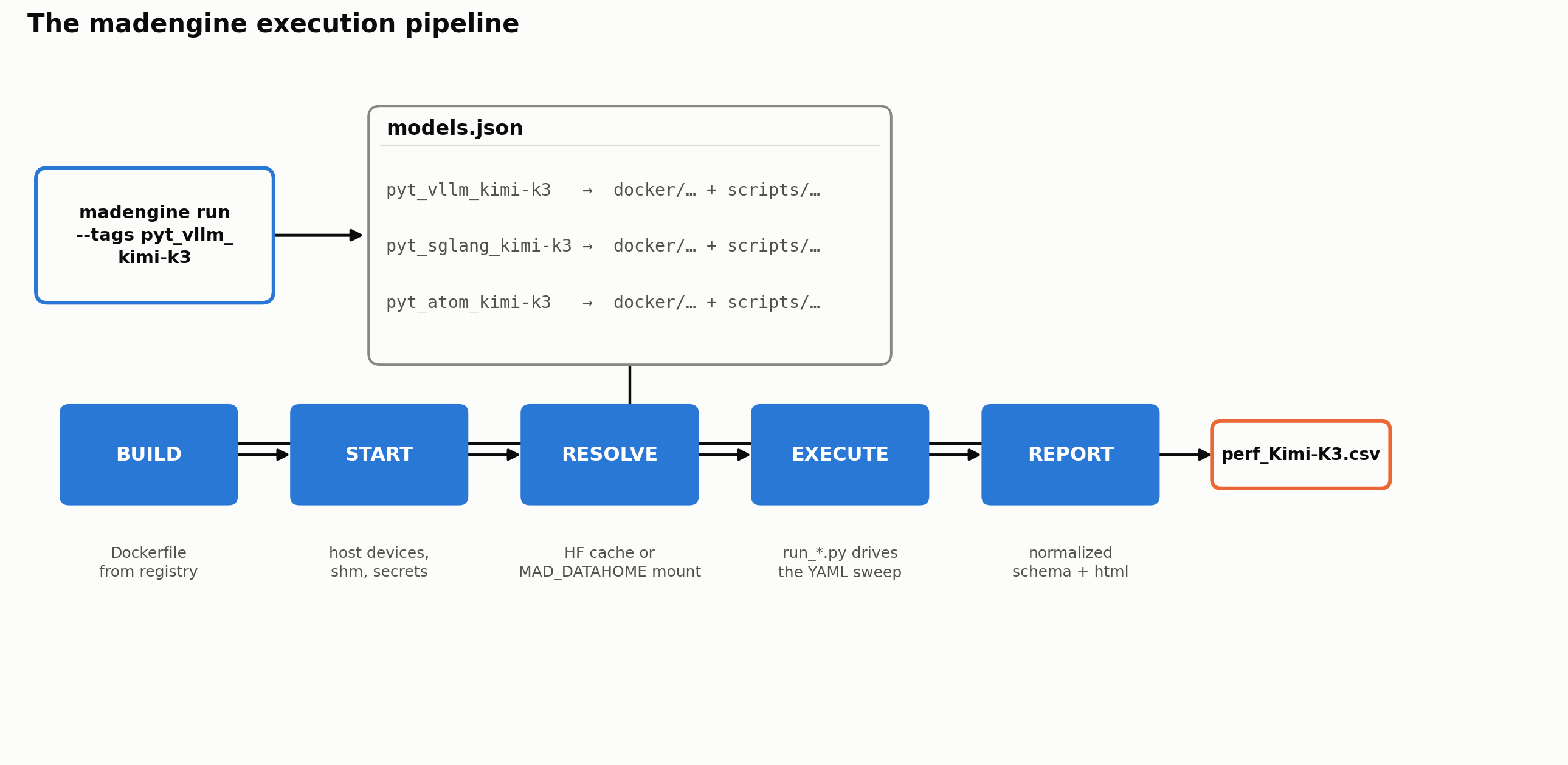
Figure 1: The madengine execution pipeline. One registry entry drives all five stages.
What changes between engines is which row of models.json you select.
For every model, madengine performs the same five steps: Build → Start → Resolve → Execute → Report, regardless of which engine sits underneath. That uniformity is the whole point: the operator experience is the same across vLLM, SGLang, and ATOM, even though the internals differ substantially.
The Registry Entry Is the Contract#
Here are the fields that make Kimi-K3-on-vLLM a one-command benchmark. The real entry
also carries bookkeeping fields, url, owner, training_precision, and timeout,
omitted here for readability:
{
  "name": "pyt_vllm_kimi-k3",
  "dockerfile": "docker/pyt_vllm_kimi_k3",
  "scripts": "scripts/vllm/run.sh",
  "data": "huggingface",
  "n_gpus": "-1",
  "multiple_results": "perf_Kimi-K3.csv",
  "tags": ["pyt", "vllm", "inference"],
  "skip_gpu_arch": "gfx942",
  "args": "--model_repo moonshotai/Kimi-K3 --config configs/default.yaml"
}
Three engines, three near-identical entries, differing only in dockerfile,
scripts, and config. The SGLang entry even ships two variants, nospec and
dspark for speculative decoding, from the same script by passing --variant, and the
same perf_Kimi-K3.csv collects them all.
{ "name": "pyt_sglang_kimi-k3",
  "scripts": "scripts/sglang/run_kimi_k3.sh",
  "args": "--model_repo moonshotai/Kimi-K3 --config configs/kimi_k3.yaml --variant nospec" }

{ "name": "pyt_sglang_kimi-k3_dspark",
  "scripts": "scripts/sglang/run_kimi_k3.sh",
  "args": "--model_repo moonshotai/Kimi-K3 --config configs/kimi_k3.yaml --variant dspark" }
What’s Actually Running Under Those Five Stages#
Figure 1 is the operator’s view. Figure 2 shows the same pipeline internally:
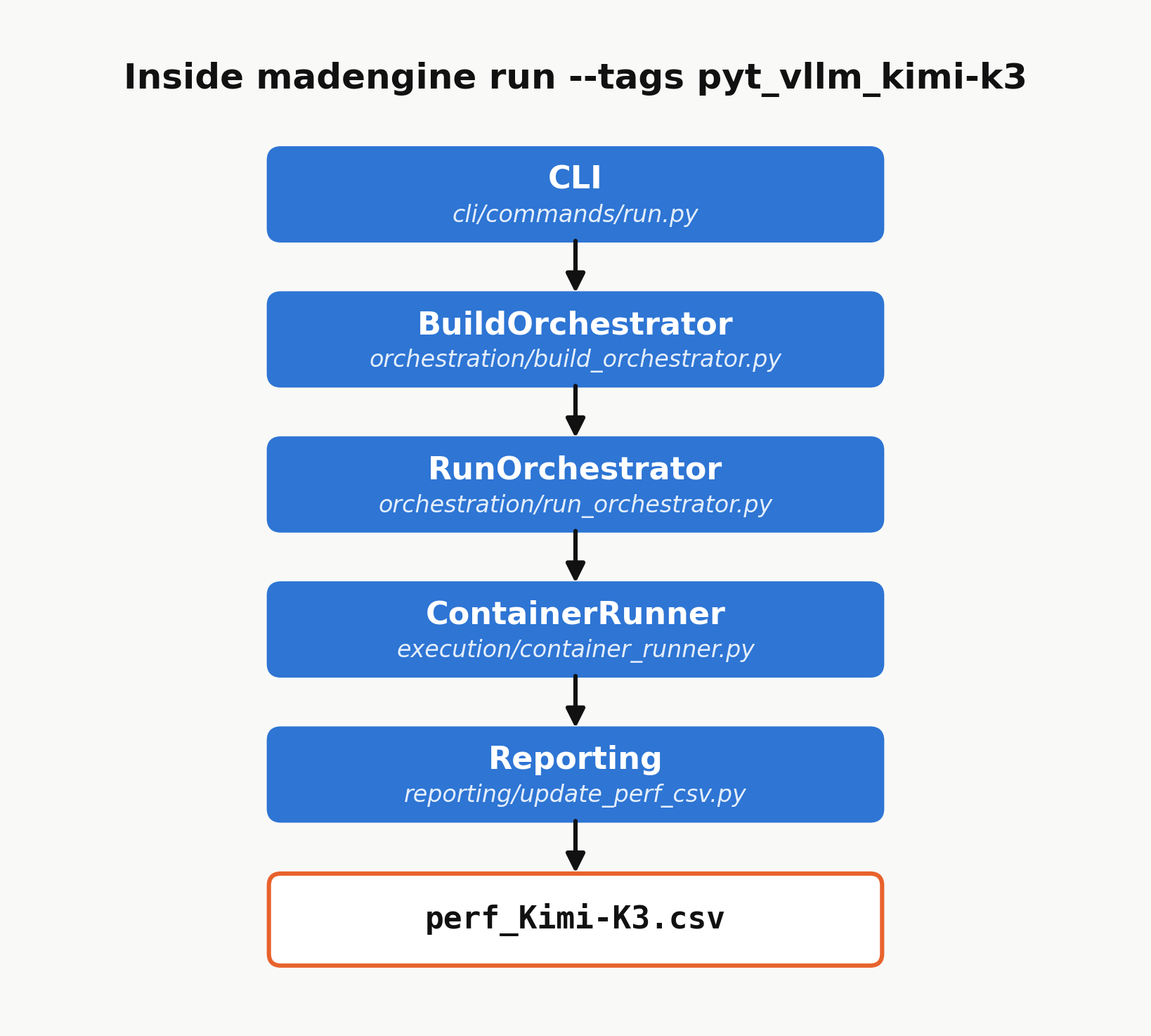
Figure 2: madengine’s internal call chain for a Kimi-K3 run. The same classes handle every model in the registry.
madengine run resolves the registry entry, builds an image from the entry’s
dockerfile, reads the host GPU architecture from rocminfo, which reports gfx950
on MI350X and MI355X and gfx942 on MI300X and MI325X, and checks it against
skip_gpu_arch. It then resolves MAD_DATAHOME for the "data": "huggingface" entry,
launches the container, and runs the entry’s scripts inside it. The script writes
perf_Kimi-K3.csv. madengine passes the multiple_results value in as
MAD_OUTPUT_CSV, and folds the result into the run-level perf.csv. None of this is
Kimi-K3-specific: enabling K3 meant adding models.json rows, Dockerfiles, and run
scripts, with no changes to madengine itself. See the
madengine repository for the implementation.
The Config Is the Recipe#
The benchmark recipe lives in version-controlled YAML, not in a person’s terminal history. Every server flag, every environment toggle that selects a kernel path, and every sweep axis is declarative and auditable.
Here is the Kimi-K3 block of the vLLM config, scripts/vllm/configs/default.yaml,
lightly abridged. The comments are condensed and a trailing bench_args block that
disables the GSM8K accuracy run is omitted:
- benchmark: serving
  model: moonshotai/Kimi-K3
  tp: 8
  inp: 8192
  out: 1024
  dtype: auto
  max_concurrency: 1 4 8 16 32 64 128 256      # the shared K3 sweep
  env:
    VLLM_ROCM_USE_AITER: 1
    SAFETENSORS_FAST_GPU: 1
    AITER_SITUV2_A8W4: 1                        # selects the aiter a8w4 MoE path
    AITER_BF16_FP8_MOE_BOUND: 0
    VLLM_USE_BREAKABLE_CUDAGRAPH: 0
  extra_args:
    --moe-backend: auto
    --load-format: auto
    --gpu-memory-utilization: 0.95
    --mm-encoder-tp-mode: data                  # MoonViT-V2 is 401M; TP is pure overhead
    --max-num-seqs: 256
    --max-num-batched-tokens: 4096
    --reasoning-parser: kimi_k3                  # K3 emits reasoning tokens by default
    --language-model-only: true                 # text-only bench frees VRAM for KV
Notice that the comments encode why each knob is set: AITER_SITUV2_A8W4: 1 selects
the AITER a8w4 MoE path, and --mm-encoder-tp-mode: data is set because MoonViT-V2 has
only 401M params, making TP on it pure communication overhead. The recipe is
self-documenting, and re-running it a month later on a different cluster repeats the
same configuration, because the run parameters live in the config rather than in the
shell it was launched from.
Harness Guardrails#
Automation that produces wrong numbers quickly is worse than no automation. The MAD flow includes several guardrails so that a run that reports success is a run that measured what it claims to measure.
1. Server-Health Gating Before Measurement#
Every serving runner launches the server as a subprocess and polls it to readiness before sending a benchmark request, so that the load time of a 1.56 TB checkpoint is not counted as request latency:
# poll until the server is healthy, then start the benchmark client
until curl -s http://localhost:8000/v1/models; do sleep 30; done
vLLM’s runner allows 30 minutes for that poll. Both SGLang and ATOM raise it to 5400
seconds, appropriate for a multi-terabyte checkpoint. SGLang polls /health rather
than /v1/models, and ATOM’s _wait_for_server() also watches the server process
itself, returning as soon as that process exits rather than waiting for the full
timeout to elapse.
2. Common Core Output Schema#
Every engine, no matter its native JSON format, is parsed into a common CSV core, so downstream dashboards and regression checks do not need to special-case the engine:
model, benchmark, tp, inp, out, num_prompts,
max_concurrency, cmd, performance, metric, unit
Each runner adds a few engine-native columns on top of that shared core. vLLM adds
dtype and bs. SGLang adds variant, for the nospec and dspark split, and
dtype. ATOM adds kv_cache_dtype, hf_pipeline_tag, and bs. Each engine’s run
produces its own perf_Kimi-K3.csv, and update_perf_csv merges each into the
run-level perf.csv, carrying over any columns the base file doesn’t already have, so
engine-specific columns are preserved even though the three engines don’t emit
byte-identical headers.
The runner records not just throughput but a set of common latency metrics:
median_ttft, median_tpot, median_itl, median_e2el, plus the cmd that
produced the row, so each row in the CSV records the invocation that generated it.
These are medians. The CSV does not carry the full latency distribution, though each
engine’s raw result JSON retains the percentiles requested via --percentile-metrics.
Metric |
Meaning |
Unit |
|---|---|---|
|
Total token throughput |
tok/sec |
|
Output (generation) throughput |
tok/sec |
|
Time to first token |
ms |
|
Time per output token |
ms |
|
Inter-token latency |
ms |
|
End-to-end latency |
ms |
Table 6: The common core metric schema emitted for every engine and every concurrency point. Shared columns make cross-engine and cross-run comparison mechanical. Each engine adds its own extra columns on top.
3. Reproducible Weights, Cached Once#
The data: "huggingface" field wires in weight resolution. By default, weights come
from the Hub, using hf-transfer for speed and MAD_SECRETS_HFTOKEN for gated repos,
but MAD_DATAHOME transparently redirects to a pre-downloaded local copy, so the
same 1.56 TB checkpoint is fetched once and reused across every engine and every rerun:
madengine run --tags pyt_vllm_kimi-k3 --keep-model-dir --live-output \
  --additional-context '{"docker_mounts": {"/model_weights": "/path/to/Kimi-K3"},
                         "docker_env_vars": {"MAD_DATAHOME": "/model_weights"}}'
--keep-model-dir preserves that cache between runs. --live-output streams the
unbuffered logs so a long sweep is observable in real time rather than a black box.
4. Hardware-Aware Gating#
Today’s registry entries mark Kimi-K3 skip_gpu_arch: gfx942, because the day-0
recipes on all three engines assume the model’s native MXFP4 weights sit on the gfx950
generation (MI350X and MI355X) and run a dense TP8 layout:
"skip_gpu_arch": "gfx942"
madengine reads the host’s MAD_SYSTEM_GPU_ARCHITECTURE, the ROCm architecture string
rocminfo reports (gfx942 on MI300X and MI325X), and skips the workload rather than
silently producing a result under the wrong assumptions. That gate records the
validated scope of this recipe: the configurations benchmarked here were written and
validated for gfx950, and skip_gpu_arch keeps them from running outside it. madengine’s
arch_overrides block is the general mechanism the shipped configs use to vary settings
by GPU architecture.
Bring Your Own Sweep: Custom ISL and OSL Settings#
The shared ISL 8192, OSL 1024 sweep exists to align the three engines with each other
and with the framework authors’ published figures. It is almost certainly not your
workload. A summarization service runs long input and short output. A code assistant
runs the reverse. An agentic loop runs neither. Kimi-K3’s headline spec is a 1M-token
context, which 8192 barely touches. This post contains no long-context data: inp has
not been pointed at 32k, 128k, or beyond on any of the three engines. That is the
natural next data point, and the harness below is what you would use to generate it.
1. Copy the Config, Change the Shape#
In your clone of MAD, copy the shipped K3 block into a new file next to it. The
configs/ directory alongside the runner is the path the container will look in:
cp scripts/vllm/configs/default.yaml scripts/vllm/configs/custom.yaml
Then trim it to the single block you care about and change the workload axes:
# scripts/vllm/configs/custom.yaml — a 2k/2k sweep instead of the shared 8k/1k
- benchmark: serving
  model: moonshotai/Kimi-K3
  tp: 8
  inp: 2048          # your input sequence length
  out: 2048          # your output sequence length
  dtype: auto
  max_concurrency: 1 8 32 64        # your concurrency points
  env:
    VLLM_ROCM_USE_AITER: 1
    SAFETENSORS_FAST_GPU: 1
    AITER_SITUV2_A8W4: 1            # keep this — dropping it silently
    AITER_BF16_FP8_MOE_BOUND: 0     # falls back to the slower a16w4 MoE path
    VLLM_USE_BREAKABLE_CUDAGRAPH: 0
  extra_args:
    --moe-backend: auto
    --gpu-memory-utilization: 0.95
    --max-num-seqs: 256
    --max-num-batched-tokens: 4096
    --reasoning-parser: kimi_k3
    --language-model-only: true
The env and extra_args blocks are the tuned part of the recipe. Carry them over
verbatim unless you are deliberately measuring one of those knobs. AITER_SITUV2_A8W4
in particular selects the fast MoE kernel path. A “custom config” that quietly omits it
produces numbers that look like a regression, but the cause is really a misconfiguration.
2. Point a Run at It#
--additional-context overrides the registry entry for a single invocation:
madengine run --tags pyt_vllm_kimi-k3 --keep-model-dir --live-output \
  --additional-context '{"model_args": "--model_repo moonshotai/Kimi-K3 --config configs/custom.yaml",
                         "docker_mounts": {"/model_weights": "/shareddata/Kimi-K3"},
                         "docker_env_vars": {"MAD_DATAHOME": "/model_weights"}}'
Two things are easy to get wrong here:
model_argsreplaces the registry’sargsstring: it does not merge with it. Whatever you pass is the complete argument list handed to the run script, so--model_repo moonshotai/Kimi-K3has to be restated alongside your--config. Passing only--config configs/custom.yamlleaves the model repo empty and the run script exits on a missing argument.The whole thing is one JSON object. All three keys,
model_args,docker_mounts, anddocker_env_vars, live inside a single pair of braces in a single pair of quotes.
There is also a shorthand. All three run scripts accept CONFIG as an environment
variable, so you can select a config without restating the model repo at all:
madengine run --tags pyt_vllm_kimi-k3 --keep-model-dir --live-output \
  --additional-context '{"docker_env_vars": {"CONFIG": "configs/custom.yaml",
                                             "MAD_DATAHOME": "/model_weights"},
                         "docker_mounts": {"/model_weights": "/shareddata/Kimi-K3"}}'
3. Where the File Has to Live#
The config path is resolved inside the container, relative to the scripts directory
that madengine copies in, so configs/custom.yaml means
scripts/vllm/configs/custom.yaml in your checkout. A YAML sitting in /tmp on the
host will not be found. If you would rather not put the file in the repo, mount it and
pass an absolute container path instead:
--additional-context '{"docker_mounts": {"/cfg": "/home/me/sweeps"},
                       "docker_env_vars": {"CONFIG": "/cfg/custom.yaml"}}'
The same three flags work for the other two engines. The difference is which
config the entry starts from: scripts/sglang/configs/kimi_k3.yaml for SGLang, which
also takes --variant nospec|dspark, and scripts/atom/configs/default.yaml for ATOM.
What You Give Up#
A custom sweep is no longer comparable to Figure 3, Table 10, or the framework tracking
issue: those numbers apply at ISL 8192, OSL 1024. That is a fair trade when the
question is “how does K3 serve my traffic on this node,” and the wrong tool when the
question is “is this engine faster than that one.” Keep the shared sweep for the second
question. Because the core schema is shared, both sets of numbers land in the same
perf_Kimi-K3.csv shape, so you can carry both.
Knob |
What it changes |
Watch out for |
|---|---|---|
|
Input / output sequence length |
Long |
|
Sweep points (space-separated) |
Each value is a full server-side run, so cost scales linearly |
|
Tensor parallel degree |
TP8 is the configuration measured here, and lower TP degrees were not evaluated |
|
vLLM server flags |
Passed through verbatim to |
|
Kernel-path selection |
Dropping |
Table 7: The knobs most worth editing in a custom config.
Benchmark Methodology#
This section states exactly how the numbers in Figure 3 and Table 10 were produced: what the workload is, what commands ran, how each metric is defined, and how a row in the CSV becomes a point on the chart. Everything below is emitted by the runner scripts from the configs shown earlier, so re-running the commands in Get Started regenerates it.
Workload Definition#
All three engines are driven with synthetic random prompts, not a natural-text dataset, so the workload is fully specified by four numbers and needs no external data download:
Property |
Value |
Notes |
|---|---|---|
Benchmark mode |
Online serving (OpenAI-compatible HTTP endpoint) |
Not offline batch throughput |
Dataset |
|
Synthetic token sequences drawn from the model’s own tokenizer vocabulary |
Input sequence length (ISL) |
8192 tokens |
vLLM and SGLang pin it exactly; ATOM samples over |
Output sequence length (OSL) |
1024 tokens |
vLLM and ATOM force it with |
Requests per point |
|
10 at concurrency 1, up to 1280 at concurrency 128 |
Concurrency points |
1, 4, 8, 16, 32, 64, 128 |
One full run per point |
Request arrival |
|
All requests are released at once; the client’s |
Sampling |
vLLM |
Output length is fixed by OSL, so sampling affects content, not the token count measured |
Tensor parallelism |
TP8 across 8× MI350X |
Single node, single server process |
Prefix caching |
Disabled on all three engines |
Identical prompts must not be served from cache |
Table 8: Workload definition for every data point in this post. num_prompts is derived
as 10 × max_concurrency by all three runners, which keeps each point roughly 10 batches
deep rather than a fixed prompt count that would be trivially short at high concurrency.
Two properties of the run loop matter for reproducibility. First, each concurrency
point gets a fresh server: the runner launches the server, polls it to readiness, runs
the client once, then sends an interrupt signal to the server and its child processes
before moving to the next point. No KV cache, no compiled-graph state, and no scheduler state carry across
points. Second, there is no warm-up phase on the serving path, so each point includes
whatever first-request compilation or autotuning the engine performs. The offline
vllm bench latency path in the same runner does use --num-iters-warmup 3, but that
path is not used here.
Exact Commands, Per Engine#
madengine emits these from the configs shown earlier. They are reproduced here with the
concurrency-32 point substituted in, so --max-concurrency 32 and --num-prompts 320
are the only values that change across the sweep. Each engine’s pair of commands is also
recorded verbatim in the cmd column of perf_Kimi-K3.csv, joined by a semicolon.
vLLM#
# server
VLLM_ROCM_USE_AITER=1 SAFETENSORS_FAST_GPU=1 AITER_SITUV2_A8W4=1 \
AITER_BF16_FP8_MOE_BOUND=0 VLLM_USE_BREAKABLE_CUDAGRAPH=0 \
vllm serve moonshotai/Kimi-K3 --dtype auto -tp 8 \
  --no-enable-prefix-caching --trust-remote-code --disable-uvicorn-access-log \
  --moe-backend auto --load-format auto --gpu-memory-utilization 0.95 \
  --mm-encoder-tp-mode data --max-num-seqs 256 --max-num-batched-tokens 4096 \
  --reasoning-parser kimi_k3 --language-model-only

# client
vllm bench serve --model moonshotai/Kimi-K3 \
  --percentile-metrics ttft,tpot,itl,e2el --dataset-name random \
  --ignore-eos --temperature 0 --trust-remote-code \
  --max-concurrency 32 --num-prompts 320 \
  --random-input-len 8192 --random-output-len 1024 \
  --save-result --result-filename Kimi-K3_serving_8_8192_1024_320_32.json
SGLang#
Shown here is the nospec variant. The dspark variant is the same server plus
--speculative-algorithm DSPARK and
--speculative-draft-model-path RadixArk/Kimi-K3-DSpark:
# server
SGLANG_USE_AITER=1 SGLANG_AITER_K3_OPT=1 AITER_FLYDSL_FORCE=1 AITER_SITUV2_A8W4=1 \
sglang serve --model-path moonshotai/Kimi-K3 --dtype bfloat16 --tp-size 8 \
  --trust-remote-code --host 127.0.0.1 --port 30000 \
  --attention-backend triton --mem-fraction-static 0.85 \
  --cuda-graph-max-bs-decode 256 --disable-radix-cache \
  --reasoning-parser kimi_k3 --tool-call-parser kimi_k3

# client
python3 -m sglang.benchmark.serving --backend sglang \
  --host 127.0.0.1 --port 30000 --model moonshotai/Kimi-K3 \
  --dataset-name random --random-input-len 8192 --random-output-len 1024 \
  --random-range-ratio 1.0 --max-concurrency 32 --num-prompts 320 \
  --output-file Kimi-K3_nospec_serving_8_8192_1024_320_32.jsonl
ATOM#
# server
ATOM_LOADER_USE_THREADPOOL=1 ATOM_LOADER_THREADPOOL_WORKERS=16 ATOM_SYNC_AFTER_LOAD=1 \
ATOM_DIST_TIMEOUT_SECONDS=3600 ATOM_USE_TRITON_GEMM=1 AITER_USE_GROUPED_GEMM=0 \
ATOM_USE_TRITON_MOE=0 AITER_FLYDSL_FORCE=1 AITER_FORCE_GFX1250=0 \
ATOM_USE_UNIFIED_ATTN=1 ATOM_FORCE_ATTN_TRITON=1 \
python -m atom.entrypoints.openai_server --model moonshotai/Kimi-K3 -tp 8 \
  --kv_cache_dtype fp8 --trust-remote-code --max-model-len 16384 \
  --max-num-seqs 256 --max-num-batched-tokens 10240 \
  --gpu-memory-utilization 0.93 --block-size 128 --no-enable_prefix_caching

# client
python -m atom.benchmarks.benchmark_serving --model moonshotai/Kimi-K3 \
  --backend vllm --base-url http://localhost:8000 \
  --percentile-metrics ttft,tpot,itl,e2el --dataset-name random \
  --ignore-eos --request-rate inf --random-range-ratio 0.8 \
  --max-concurrency 32 --num-prompts 320 \
  --random-input-len 8192 --random-output-len 1024 \
  --save-result --result-dir ./ \
  --result-filename Kimi-K3_serving_8_8192_1024_320_32.json --trust-remote-code
Server-Side Settings Side by Side#
The workload axes in Table 8 are aligned across engines. The server-side memory and scheduling knobs are each engine’s day-0 recipe values and are not normalized, which is part of why these results are an out-of-box snapshot rather than an engine comparison:
Server setting |
vLLM |
SGLang |
ATOM |
|---|---|---|---|
Weight/activation dtype |
|
|
not set (native MXFP4) |
KV cache dtype |
engine default (bf16) |
engine default (bf16) |
|
GPU memory budget |
|
|
|
Max running sequences |
|
|
|
Max batched tokens |
4096 |
engine default |
10240 |
Max model length |
engine default |
engine default |
16384 |
KV block size |
engine default |
engine default |
128 |
Attention backend |
engine default |
|
|
MoE kernel path |
|
|
|
Multimodal tower |
|
not loaded by default |
not loaded by default |
Speculative decoding |
off |
off ( |
off |
Table 9: Server-side configuration as run. The differing memory budgets, KV-cache dtype, and batched-token limits are day-0 recipe defaults per engine. They are material to throughput at high concurrency, where KV capacity sets how many of the requested concurrent sequences actually run rather than queue.
Metric Definitions and Data Reduction#
The reported number is each client’s own total token throughput, not a quantity recomputed by MAD:
Total token throughput (
throughput_tot, tok/s) is(total prompt tokens + total generated tokens) / benchmark duration, where the duration spans from the first request dispatch to the last request completion. vLLM reports it astotal_token_throughput, SGLang astotal_throughput; the runners copy the field through unchanged.Output throughput (
throughput_gen, tok/s) counts generated tokens only, over the same window.median_ttft,median_tpot,median_itl,median_e2elare the medians of the per-request distributions the clients compute under--percentile-metrics ttft,tpot,itl,e2el. Only the median reaches the CSV; the full percentile set stays in each engine’s raw result JSON next to it.
Data reduction for Figure 3 and Table 10 is a filter, not an aggregation: for each engine
and each concurrency point, take the single row of perf_Kimi-K3.csv whose metric
column is throughput_tot, and plot performance against max_concurrency. Because
each point is one run, there is nothing to average and no error bar to draw. The GSM8K
accuracy stage is switched off for vLLM in the config (--run_accuracy: False), because
K3’s always-on reasoning tokens exhaust lm_eval’s hardcoded 2048-token generation
budget over /v1/completions and produce a meaningless score, so no accuracy number is
claimed anywhere in this post.
Reproduction Checklist#
To land on comparable numbers, the elements that must match are, in rough order of how much they move the result:
Hardware and software stack: 8× MI350X (gfx950), ROCm 7.2.3, amdgpu 6.16.13 (Table 2).
Images by digest, not tag (Table 3): both the vLLM and SGLang tags moved within a single build session.
Model revision
9f62e4e9…, fetched once and shared viaMAD_DATAHOME.MAD
a20c885and madenginev2.1.2, so the runners emit the commands above.The stock configs, unedited, especially the
envblocks: droppingAITER_SITUV2_A8W4silently selects a slower MoE path and looks like a regression.One server per concurrency point, which the runner does for you.
Results: Out-of-Box, All Three Engines#
Reproducing the day-0, three-engine benchmark is three commands:
# vLLM — 8k/1k serving sweep, TP8
madengine run --tags pyt_vllm_kimi-k3   --keep-model-dir --live-output

# SGLang — same sweep; add the _dspark tag for speculative decoding
madengine run --tags pyt_sglang_kimi-k3 --keep-model-dir --live-output

# ATOM — same sweep, fp8 KV cache
madengine run --tags pyt_atom_kimi-k3   --keep-model-dir --live-output
Each produces a perf_Kimi-K3.csv sharing the same core columns, so stacking the three
CSVs lines the concurrency axis up row-for-row.
Below is an out-of-box madengine run on 8× MI350X, all three engines, no tuning beyond
the shared config in this post.
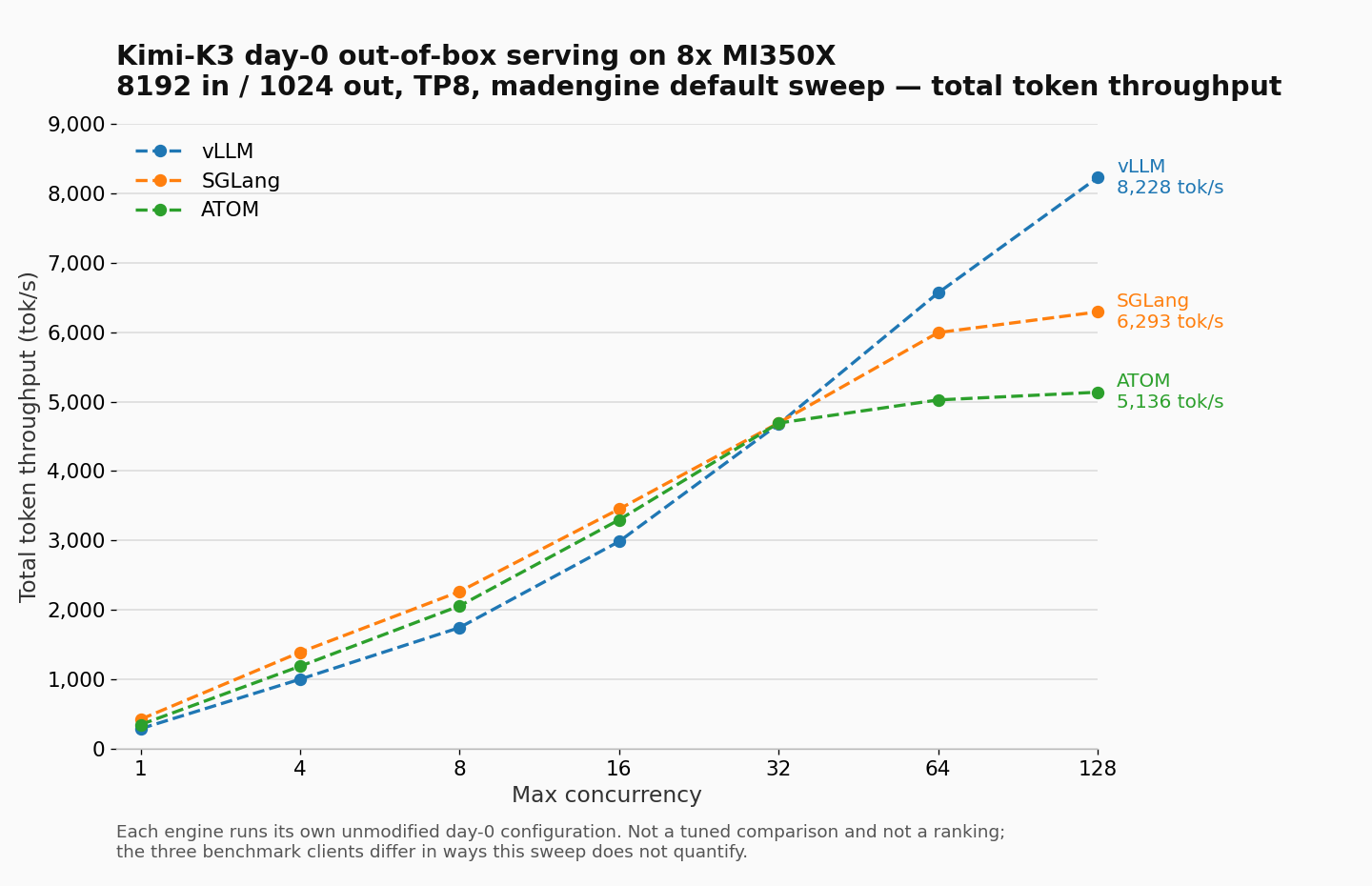
Figure 3: Out-of-box snapshot. Total token throughput vs. max concurrency, 8192 in, 1024 out, TP8, 8× MI350X, measured 2026-07-29. All three engines are from the same madengine sweep, each using its day-0 out-of-box configuration, with one run per concurrency point and no repetitions. This is not a tuned comparison and not a leaderboard: it is a picture of how each stack’s day-0 out-of-box configuration behaved on launch day, and it is the thing most likely to have changed by the time you re-run the command.
Two properties of the shape matter more than the ordering. First, this is a functional result before it is a performance one: a 2.8T-parameter MoE with a new attention design completes the full sweep on a single 8× MI350X node, on three separate engines, on day 0. No accuracy evaluation was run as part of this sweep, so these results establish that the model serves and produces output at the requested lengths, not that its output quality was assessed. Second, at concurrency 32 all three land on essentially the same point: 4,676, 4,694, and 4,692 tok/s, a spread under 0.5%. The spread is considerably wider below that point: at concurrency 1 the three values differ by more than 40%, and it widens again above concurrency 32. That single-point convergence is an observation about this configuration. One throughput point does not isolate which component sets the ceiling there: scheduler, kernels, precision, benchmark client, or hardware.
The curves separate past concurrency 32, where the engines’ differing scheduling and batching defaults have more room to act. Because each engine runs its own out-of-box day-0 configuration, these high-concurrency values reflect those default settings rather than a tuned result for any engine, and the differences between the three benchmark clients noted in Table 5 remain unquantified. Each engine’s day-0 configuration is a snapshot of one point in its development, and all three continue to change.
Concurrency |
vLLM (tok/s) |
SGLang (tok/s) |
ATOM (tok/s) |
|---|---|---|---|
1 |
287.28 |
422.75 |
346.12 |
4 |
1,000.47 |
1,388.58 |
1,187.52 |
8 |
1,744.78 |
2,263.67 |
2,056.96 |
16 |
2,985.02 |
3,451.65 |
3,297.54 |
32 |
4,675.92 |
4,693.86 |
4,691.54 |
64 |
6,567.25 |
5,994.97 |
5,024.71 |
128 |
8,228.15 |
6,293.32 |
5,136.26 |
Table 10: Out-of-box snapshot. Raw total-token-throughput values behind Figure 3,
straight out of each engine’s perf_Kimi-K3.csv. Measured 2026-07-29 on 8× MI350X, one
run per concurrency point, no repetitions, so these values carry no run-to-run variance
estimate. The shipped configs list concurrency 256, but the runs reported here were taken
through 128 only. 256 has not been measured on any of the three engines.
Limitations#
The measurements above are a day-0 snapshot, and the following bound what they support:
MI350X only. The recipes target gfx950 (MI350X and MI355X), but every number here comes from an 8× MI350X node. MI355X has not been measured.
Throughput only, no accuracy evaluation. The sweep measures serving throughput and latency; the GSM8K accuracy run is disabled in the configs used here, so output quality was not assessed on any of the three engines.
Single run per point. Each concurrency point is one measurement over
10 × concurrencyprompts, with no repetitions and no warm-up iterations on the serving path. There is no run-to-run variance estimate, so small cross-engine differences should not be over-read.Concurrency 256 unmeasured. The shipped configs list it; no engine has run it, so the config’s sweep list is wider than the measured range reported here.
Bench-client defaults not normalized. The prompt-length sampling and EOS differences in Table 5 are unquantified. No A/B run has isolated their effect.
No long-context data. Kimi-K3 supports a 1M-token context; the sweep uses 8192. Long-context behavior on all three engines is unmeasured.
Mutable image tags. The digests in Table 3 identify exactly what ran, but the vLLM and SGLang Dockerfiles reference their base images by tag, and both tags were observed serving a different digest within the same build session. Anyone rebuilding from the tag today may not get the image benchmarked here. The upstream framework commits inside those containers are also not recorded.
The Same Pattern Across the MAD Catalog#
The same registry-plus-runner pattern used for Kimi-K3 already spans the AMD MAD
catalog: vLLM, SGLang, ATOM, Primus and Megatron training, JAX MaxText, xDiT diffusion,
and disaggregated prefill and decode (P/D) serving, all driven by the same
madengine run --tags … interface and the same declarative configs.
That uniformity makes day-0 support repeatable rather than a one-off:
For model launches: enabling a new model on a new engine is a registry entry, a Dockerfile, and a YAML, reviewable in a PR, not lost in a shell session.
For CI and regression: the shared core schema and shared sweeps mean a nightly job can diff today’s
perf_Kimi-K3.csvagainst a reference and flag drift automatically.For the community: anyone with an 8× MI350X node can reproduce this benchmark from the configs in the repo, subject to the version pins in Table 3.
As Moonshot AI and the framework teams extend agentic serving, with longer horizons, deeper tool use, and larger context, the same harness is what makes each step measurable on AMD Instinct™ hardware.
Get Started#
To reproduce the runs in this post, pin both repositories to the versions in Table 3
rather than tracking main:
pip install git+https://github.com/ROCm/madengine.git@v2.1.2
git clone https://github.com/ROCm/MAD.git && cd MAD
git checkout a20c885

# pick your engine
madengine run --tags pyt_vllm_kimi-k3   --keep-model-dir --live-output
madengine run --tags pyt_sglang_kimi-k3 --keep-model-dir --live-output
madengine run --tags pyt_atom_kimi-k3   --keep-model-dir --live-output
To pin the checkpoint to the exact revision benchmarked here, fetch it once by revision
and point MAD_DATAHOME at the result:
hf download moonshotai/Kimi-K3 \
  --revision 9f62e4e9fffbd0a83ddd60e1c209d828994b3569 \
  --local-dir /shareddata/Kimi-K3
madengine: github.com/ROCm/madengine
Summary#
In this blog you explored how MAD’s declarative model registry and its madengine runner turn day-0 Kimi-K3 enablement on AMD Instinct™ MI350X into a single reproducible command per engine. You saw what a registry entry contains and how madengine expands it into the Build, Start, Resolve, Execute, and Report pipeline; how one shared sweep of 8192 input and 1024 output tokens at TP8 across seven concurrency points is expressed in versioned YAML rather than in shell history; how the harness gates on server health, caches weights, and guards against unvalidated GPU architectures; and how to retarget the whole sweep to your own ISL, OSL, and concurrency by copying one config. You also saw the out-of-box day-0 numbers the flow produced for vLLM, SGLang, and ATOM, together with an explicit account of what one run per point, with server settings that are not normalized across engines, does and does not establish.
The same registry-plus-runner pattern already covers training, diffusion, and
disaggregated prefill and decode serving across the MAD catalog, so the next step is to
run it on your own cluster: clone MAD at the pinned commit, launch the engine you care
about, and diff your perf_Kimi-K3.csv against the configuration published here. Our
team will keep extending this harness as agentic serving workloads grow longer horizons
and larger context, and future posts will cover tuned configurations, multi-node
scaling, and disaggregated serving on AMD Instinct™ GPUs.
Additional Resources#
Kimi-K3: Moonshot AI’s 2.8T-parameter Mixture-of-Experts LLM
MAD: Model Automation and Dashboarding for AMD Instinct GPUs
madengine: The MAD execution engine and CLI
vLLM: High-throughput serving engine for large language models
SGLang: Fast serving framework for large language models
AITER: AI Tensor Engine for ROCm
Disclaimers#
Testing conducted by AMD on 2026-07-29. Hardware configuration: Supermicro
AS-8126GS-TNMR with 8× AMD Instinct™ MI350X (gfx950), 2× AMD EPYC 9575F, 3 TiB DDR5
system memory, Ubuntu 24.04, ROCm 7.2.3, amdgpu driver 6.16.13, TP8. Kimi-K3 checkpoint
≈ 1.56 TB (revision 9f62e4e9). The recipes target the
gfx950 generation (MI350X and MI355X). MI355X was not measured. Workload: online serving
of synthetic random prompts, 8192 input tokens and 1024 output tokens, 10 × concurrency
requests per point, request rate inf, prefix caching disabled, concurrency swept over
1/4/8/16/32/64/128, with a fresh server process per concurrency point and no warm-up.
Reported throughput is each benchmark client’s own total token throughput. Results
reflect out-of-box engine configurations with one run per data point and no repetitions;
server-side settings are not normalized across engines. See Tables 2 and 3 for the full
system and version configuration, Tables 8 and 9 for the workload and server
configuration, and the verbatim commands in the Benchmark Methodology section.
Third-party content is licensed to you directly by the third party that owns the content and is not licensed to you by AMD. ALL LINKED THIRD-PARTY CONTENT IS PROVIDED “AS IS” WITHOUT A WARRANTY OF ANY KIND. USE OF SUCH THIRD-PARTY CONTENT IS DONE AT YOUR SOLE DISCRETION AND UNDER NO CIRCUMSTANCES WILL AMD BE LIABLE TO YOU FOR ANY THIRD-PARTY CONTENT. YOU ASSUME ALL RISK AND ARE SOLELY RESPONSIBLE FOR ANY DAMAGES THAT MAY ARISE FROM YOUR USE OF THIRD-PARTY CONTENT.
Results shown are from specific test configurations and may vary based on workload, model, and system configuration.
The information presented in this document is for informational purposes only and may contain technical inaccuracies, omissions, and typographical errors. The information contained herein is subject to change and may be rendered inaccurate for many reasons, including but not limited to product and roadmap changes, component and motherboard version changes, new model and/or product releases, product differences between differing manufacturers, software changes, BIOS flashes, firmware upgrades, or the like. Any computer system has risks of security vulnerabilities that cannot be completely prevented or mitigated. AMD assumes no obligation to update or otherwise correct or revise this information. However, AMD reserves the right to revise this information and to make changes from time to time to the content hereof without obligation of AMD to notify any person of such revisions or changes. THIS INFORMATION IS PROVIDED “AS IS.” AMD MAKES NO REPRESENTATIONS OR WARRANTIES WITH RESPECT TO THE CONTENTS HEREOF AND ASSUMES NO RESPONSIBILITY FOR ANY INACCURACIES, ERRORS, OR OMISSIONS THAT MAY APPEAR IN THIS INFORMATION. AMD SPECIFICALLY DISCLAIMS ANY IMPLIED WARRANTIES OF NON-INFRINGEMENT, MERCHANTABILITY, OR FITNESS FOR ANY PARTICULAR PURPOSE. IN NO EVENT WILL AMD BE LIABLE TO ANY PERSON FOR ANY RELIANCE, DIRECT, INDIRECT, SPECIAL, OR OTHER CONSEQUENTIAL DAMAGES ARISING FROM THE USE OF ANY INFORMATION CONTAINED HEREIN, EVEN IF AMD IS EXPRESSLY ADVISED OF THE POSSIBILITY OF SUCH DAMAGES. AMD, the AMD Arrow logo, AMD Instinct, AMD EPYC, AMD ROCm, and combinations thereof are trademarks of Advanced Micro Devices, Inc. Other product names used in this publication are for identification purposes only and may be trademarks of their respective companies. Linux is the registered trademark of Linus Torvalds in the U.S. and other countries. PyTorch, the PyTorch logo, vLLM, ubuntu, and any related marks are trademarks of The Linux Foundation. All other trademarks and product names referenced in this publication, including Kimi-K3, Moonshot AI, SGLang, and Hugging Face, are the property of their respective owners. © 2026 Advanced Micro Devices, Inc. All rights reserved.