DeepSeek-V4 Flash RL on AMD Instinct MI308X GPUs with an AITER-Backed RL Stack#

We demonstrate end-to-end DeepSeek-V4 Flash reinforcement learning with an AITER-backed AMD RL stack on 24 AMD Instinct MI308X GPUs. Our test covers the complete workflow on three MI308X OAM nodes—not only inference or an isolated training step, but long-context FP8 rollout, BF16 MoE actor training, online RDMA weight updates, evaluation, and checkpoint recovery. Training and inference run as disaggregated services: two MI308X nodes host a BF16 actor that preserves the numerical stability required by gradient computation and optimizer updates, while a dedicated third MI308X node hosts an FP8 rollout engine whose smaller per-parameter footprint leaves more GPU memory available for KV cache and longer generated sequences. Ray places and coordinates both GPU groups. This experiment demonstrates one tested three-node configuration for running both rollout inference and RL training on MI308X GPUs.
This post reports the first 75 optimizer steps of a long-context GRPO run on three eight-GPU AMD Instinct MI308X nodes. The AITER-backed workflow combines distributed orchestration, rollout correction, routing replay, weight transfer, evaluation, and checkpoint recovery around an FP8 rollout engine and a BF16 actor.
Key Takeaways#
DeepSeek-V4 Flash RL was tested on MI308X. The complete 24-GPU, three-node AITER-backed workflow ran on AMD Instinct MI308X OAM systems.
The MI308X deployment supports disaggregated training and inference. Two MI308X nodes run a 16-worker Megatron actor through an AMD-native training backend with AITER-backed kernels; a third MI308X node runs an eight-way tensor-parallel vLLM rollout server.
The first 75 optimizer steps maintained stable generation throughput. Mean rollout throughput was 311 generated tokens/s, with a measured range of 287–331 generated tokens/s.[1]
Online reward improved over the run. Mean reward accuracy increased from 45.3% in Steps 1–25 to 53.2% in Steps 26–50 and 59.2% in Steps 51–75.[1]
Held-out AIME-2024 accuracy improved. Accuracy over eight generations per problem increased from 30.0% at Step 1 to 49.2% at Step 75.[1]
DeepSeek-V4 Flash in the AITER-Backed RL Stack#
According to the DeepSeek-V4 technical report, DeepSeek-V4 Flash is a 284-billion-parameter mixture-of-experts model with roughly 13 billion active parameters per token. The model supports a one-million-token context window and has 43 decoder layers with a hidden size of 4,096 and a 129,280-token vocabulary. The run reported here limits the model context and total sequence length to 16,384 tokens. Every decoder block contains one shared expert and 256 routed experts, with six routed experts activated per token. The first three MoE layers use deterministic hash routing; later layers use the learned router.
The attention schedule interleaves three layer types. The first two layers use dense sliding-window attention (SWA) over 128 tokens. The remaining 41 layers alternate between 21 Compressed Sparse Attention (CSA, or C4) layers and 20 Heavily Compressed Attention (HCA, or C128) layers. CSA pools the sequence at 4:1 and selects the top 512 compressed entries; HCA pools at 128:1 and attends densely over the compressed sequence. Both retain the 128-token local branch, preserving recent-token resolution alongside long-context access.
Each attention module has 64 query heads reading a shared 512-dimensional key/value latent. Queries use a rank-1,024 low-rank path shared with the sparse indexer, while the output projection is divided into eight groups with 1,024-dimensional bottlenecks. These shapes are important to the specialized ROCm attention and projection kernels used by the AMD-native training backend.
DeepSeek-V4 Flash replaces a conventional residual connection with manifold-constrained hyper-connections (mHC) over four parallel residual streams. A pre-mixer collapses the streams into the tensor consumed by each sub-layer; a post-mixer expands the result back into the four-stream state. The rollout and actor engines must preserve this mapping, the hybrid-attention schedule, and expert assignments even though they execute different kernels and numerical formats. In this workflow, vLLM generates trajectories from an FP8 representation, while Megatron-LM uses the AMD-native DeepSeek-V4 backend and AITER-backed training kernels to score and update the policy in BF16.
Figure 1 summarizes the model components and routing path that the rollout and actor engines must preserve.
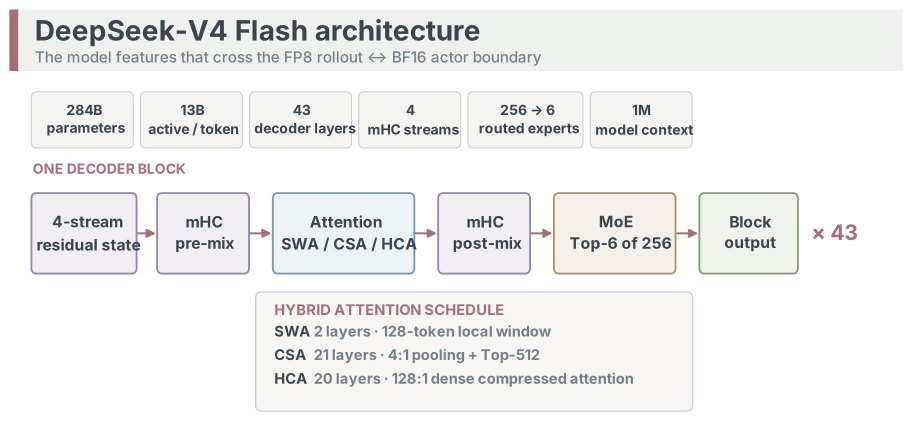
Figure 1. Simplified DeepSeek-V4 Flash block showing four-stream mHC mixing, the SWA/CSA/HCA layer schedule, and top-6 routing over 256 experts. Adapted from the DeepSeek-V4 technical report.
Why MI308X Support Matters#
This experiment shows that the tested MI308X configuration—together with the ROCm, AITER, and vLLM ecosystem around it—can support an RL training pipeline: distributed BF16 actor training with Megatron, FP8 rollout generation with vLLM, online RDMA weight updates, evaluation, and checkpoint recovery. The result is specific to the three-node configuration and software versions reported in the test configuration below.
DeepSeek-V4 Flash stresses several MI308X subsystems at once: large-capacity HBM for a 284B-class MoE policy, high-throughput FP8 execution for rollout, multi-node collectives for TP/PP/EP actor training, and RDMA for repeated online policy updates. Passing only a model-load or single-step test would not exercise this complete path.
Our 75-step result exercises this integrated workflow across all three nodes. The actor topology, optimizer offload, activation recomputation, vLLM memory headroom, AITER kernel path, and RCCL transport settings were selected specifically to make long-context DeepSeek-V4 Flash RL practical on MI308X. The MI308X actor uses TP4/PP4/EP4, while rollout uses TP8 on a dedicated node.
The AMD-native training backend supplies the DeepSeek-V4 Megatron layer specification, architecture modules, ROCm compatibility paths, quantization lifecycle abstractions, and AITER-backed operators. The surrounding RL orchestration layer provides inference integration, rollout correction, reward processing, online weight updates, evaluation, and recovery.
The AITER-Backed Execution Flow#
Figure 2 shows how the three-node deployment separates rollout from actor training while coordinating online policy updates.
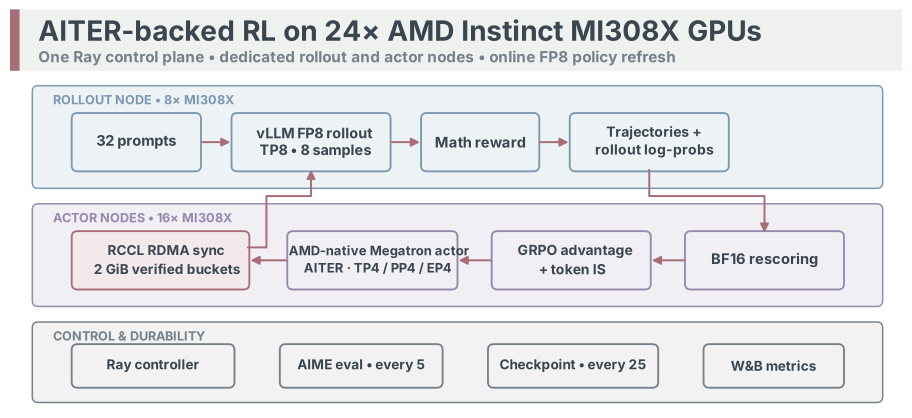
Figure 2. The disaggregated DeepSeek-V4 Flash RL workflow spans three MI308X nodes. An AMD-native backend connects the Megatron actor to the DeepSeek-V4 model specification and AITER-backed training kernels. The actor and rollout engines use independent parallel layouts and exchange updated policy weights through RCCL RDMA.
The RL orchestration layer manages the lifecycle around those engines:
sample prompts from DAPO-Math-17K;
generate eight responses per prompt with vLLM;
score the responses with the math reward;
rescore generated tokens with the Megatron actor;
form group-relative advantages;
apply token-level rollout importance-sampling correction;
update the BF16 actor;
transfer and quantize the new policy for the FP8 rollout engine;
periodically evaluate on AIME-2024 and save distributed checkpoints.
1. Ray Separates Training and Rollout#
The run uses three nodes with eight GPUs each. Ray pins 16 actor workers to two nodes and eight rollout workers to the third node. This separation lets the Megatron actor use a memory-oriented parallel layout while vLLM uses a throughput-oriented tensor-parallel layout. On the training side, the AMD-native backend provides the DeepSeek-V4 Megatron layer specification and connects AITER-backed kernels for model operations on MI308X.
The actor uses:
tensor parallelism: 4;
pipeline parallelism: 4;
expert parallelism: 4;
expert tensor parallelism: 1;
sequence parallelism and full activation recomputation;
11 layers in the first pipeline stage and 10 in the last;
distributed Adam with full optimizer-state CPU offload;
BF16 optimizer moments with 256 MiB streamed-Adam chunks.
The rollout engine uses:
vLLM AsyncLLM with tensor parallelism 8;
FP8 per-block weights and FP8 E4M3 KV cache;
AITER kernels where supported;
a 16,384-token model context and 4,096-token response cap;
up to 8,192 batched tokens and 48 concurrent sequences;
90% GPU-memory utilization.
The 90% memory target reserves GPU memory for online policy updates while retaining KV-cache capacity for long generated sequences.
2. GRPO Keeps the Policy Loop Explicit#
Each optimizer step samples 32 prompts and generates eight responses per prompt, producing a global batch of 256 trajectories. The RL orchestration layer evaluates the responses with the DAPO math reward, computes group-relative advantages, and aggregates the policy loss with sequence-mean/token-mean semantics.
The policy update uses a learning rate of 1e-6, a GRPO clipping ratio of
0.2, and an upper clipping ratio of 0.28. No explicit KL reward penalty is
enabled in this experiment.
Because rollout and training use different numerical representations, the workflow applies token-level importance-sampling correction. The correction clamps the train-versus-rollout ratio at 2.0 and applies it directly to the per-token GRPO loss. For the MoE path, hard-assignment R3 replay preserves the recorded rollout routing decisions during actor rescoring.
3. RDMA Updates a Live FP8 Rollout Engine#
After each actor update, the workflow transfers the updated policy through an RCCL-backed RDMA group. The actor remains BF16, while the rollout engine prepares the FP8 representation before the next generation cycle. Rollout resumes only after the distributed update has completed.
4. Checkpoints Make Long Runs Recoverable#
The orchestration layer saves a distributed checkpoint every 25 optimizer steps and retains the latest two checkpoints. The actor checkpoint includes model, optimizer, and scheduler state across the Megatron topology. Resume restores the actor before rebuilding the RDMA group and reloading the rollout workers.
Seventy-Five-Step Results#
All measurements in this section use the test configuration described in Endnote 1.
Held-Out AIME-2024 Evaluation#
The workflow evaluates AIME-2024 every five optimizer steps with eight generations per problem. Accuracy increased from 30.0% at Step 1 to 49.2% at Step 75, the best observed value in this window. Figure 3 shows the evaluation trajectory across the measured window.
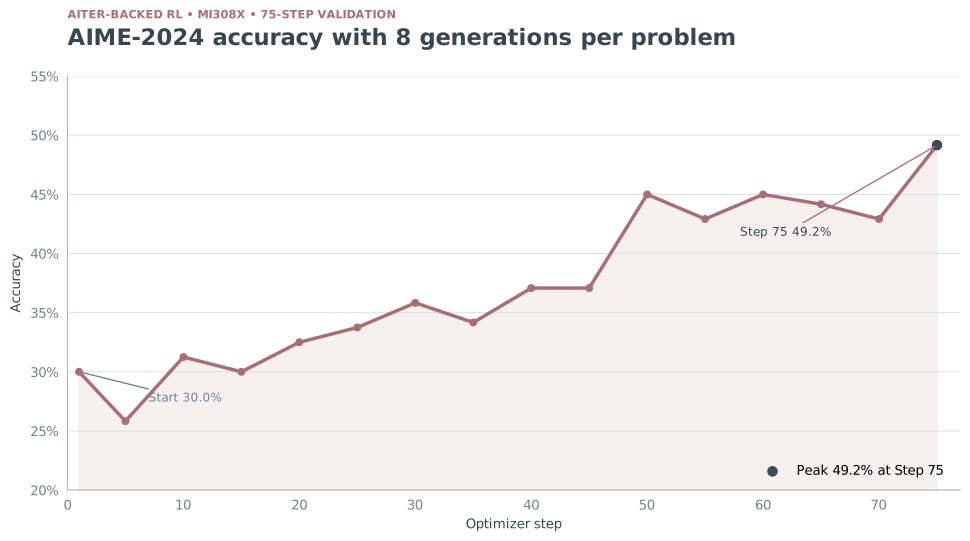
Figure 3. Held-out AIME-2024 mean accuracy over eight sampled generations per problem. Individual evaluations are noisy on a 30-problem benchmark, so the multi-evaluation trend is more informative than any single point.
Online Reward#
Reward accuracy is noisy from step to step, ranging from 26.6% to 77.7%. Aggregating the run into thirds shows the useful trend:
Steps 1–25: 45.3%
Steps 26–50: 53.2%
Steps 51–75: 59.2%
Figure 4 shows the per-step reward signal and its 10-step moving average.
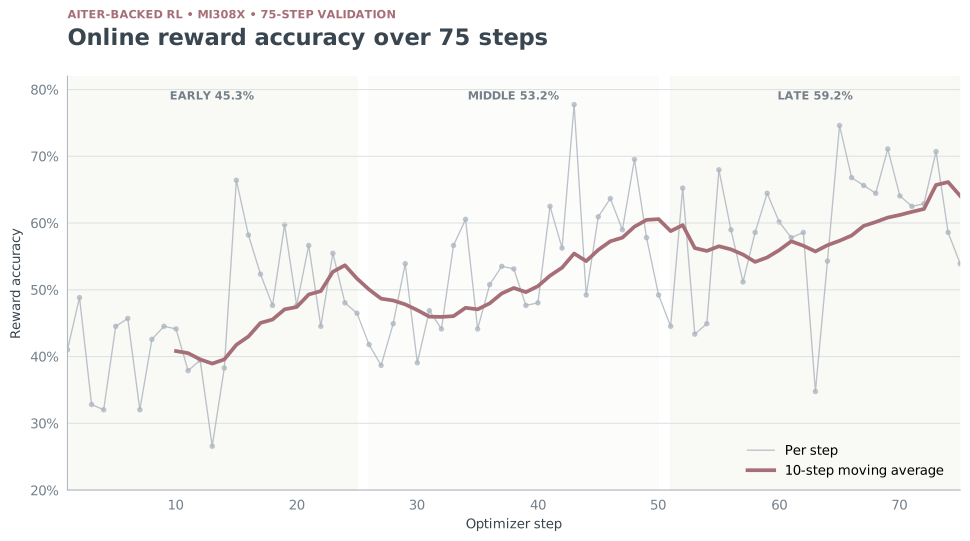
Figure 4. Online reward accuracy for each optimizer step and its 10-step moving average. The per-step signal is noisy, while the grouped means show a sustained increase relative to the first third.
Train-Versus-Rollout Minimum Log-PPL Difference#
For this analysis, the train-versus-rollout diagnostic is the signed minimum
log-PPL difference recorded by the RL workflow for each step
(rollout_corr/log_ppl_diff_min). It ranged from -0.0230 to 0.0451:
Steps 1–25 mean: -0.0102
Steps 26–50 mean: -0.0049
Steps 51–75 mean: 0.0170
Figure 5 tracks this minimum diagnostic throughout the 75-step run.
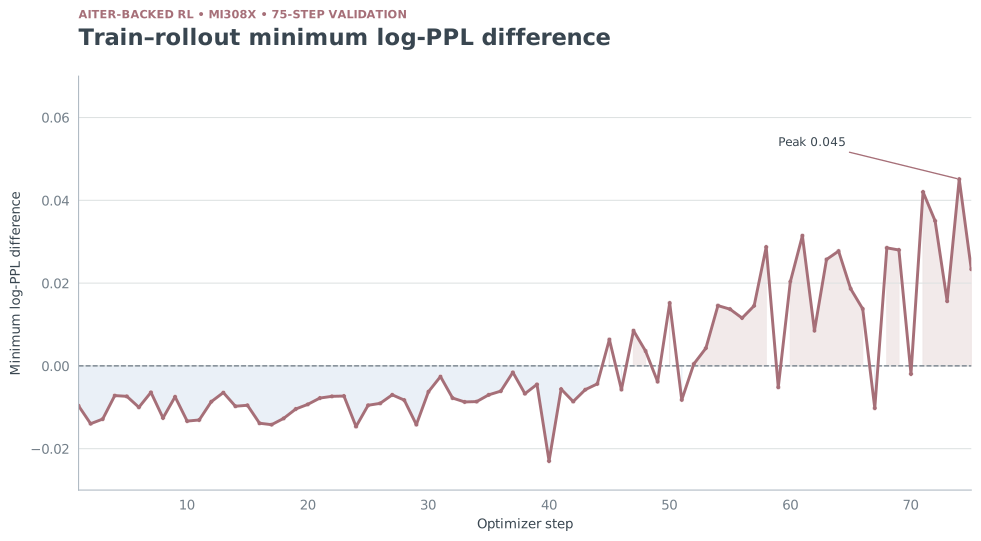
Figure 5. Signed minimum train-versus-rollout log-PPL difference over the first 75 optimizer steps. This minimum statistic captures one edge of the per-step distribution and must not be read as a complete alignment measure.
Correction diagnostics evolved alongside the policy during the run. By Step
75, rollout_corr/kl was 0.4706 and effective sample size was 79.1%. We use
these measurements as calibration signals for continued refinement of
training–inference consistency, particularly for long sequences and online
FP8 policy reloads.
Throughput#
Despite long responses and repeated online weight updates, rollout throughput remained stable:
overall mean: 311.2 generated tokens/s;
observed range: 287.0–331.0 generated tokens/s;
Steps 1–25 mean: 315.2 generated tokens/s;
Steps 26–50 mean: 309.7 generated tokens/s;
Steps 51–75 mean: 308.6 generated tokens/s.
The small decline across thirds is modest compared with the variation in sample length over this measured window.
What We Learned#
Training–inference separation makes model-specific tuning practical. Megatron and vLLM need different parallel layouts for this model. Ray role placement lets the RL stack tune each engine independently without conflating their memory and communication constraints.
Online FP8 updates require a coordinated synchronization boundary. Weight transfer, inference-side quantization, and activation of the updated policy must complete before rollout resumes.
Memory headroom is part of the communication design. The rollout KV cache and online policy update share GPU memory. The 90% vLLM utilization setting reserved update headroom without changing the model context or response budget.
Held-out evaluation and online reward answer different questions. Online reward reflects the sampled training distribution. Periodic AIME-2024 evaluation provides a separate view of capability. Both improved relative to the start over 75 steps. Neither signal removes the need to validate cross-engine policy agreement.
Recovery is part of the workflow. A 75-step trajectory at this scale spans rollout, actor, transfer, evaluation, and checkpoint phases. Versioned checkpoints and deterministic step-indexed metrics preserve continuity over the measured window.
Reproducing the Deployment#
The exact source revisions and container images used for this experiment were pinned across all three nodes. To reproduce the topology in another environment, use equivalent pinned builds that include the RL orchestration layer, the AMD-native DeepSeek-V4 Megatron backend, AITER, ROCm Megatron-LM, ROCm vLLM, Ray, and RCCL.
1. Check the Three MI308X Hosts#
Docker, the AMD GPU device files, and the RoCE device must be available on all three hosts:
docker info >/dev/null
test -e /dev/kfd
test -d /dev/dri
test -d /dev/infiniband
rocminfo | grep -c 'Name:.*gfx942'
The final command should report eight GPU agents on each host. RDMA interface,
HCA, and GID values are cluster-specific; discover them from
/sys/class/infiniband instead of copying the values from our test cluster.
2. Pin the Software Components#
Use the same revisions on every node for:
the RL orchestration and AMD-native DeepSeek-V4 training backend;
ROCm Megatron-LM and AITER-backed training kernels;
ROCm vLLM with FP8 weights and FP8 E4M3 KV cache support;
Ray and the RCCL-based RDMA weight-transfer layer.
The published trainer and rollout images already contain the pinned Python, PyTorch, ROCm, Megatron, AITER, vLLM, and RL integration code. Users can pull and start them directly instead of rebuilding the software stack on each host. The model, datasets, writable runtime directories, and cluster-specific RDMA configuration remain external.
3. Prepare Model, Data, and Runtime Directories#
The launch environment uses the following layout:
/path/to/runtime/
├── models/DeepSeek-V4-Flash-BF16/
├── data/dsv4-flash/dapo-math-17k/data/dapo-math-17k.parquet
├── data/dsv4-flash/aime-2024/test-00000-of-00001.parquet
├── logs/
└── ckpts/
Create the writable directories before starting containers:
export DATA_ROOT=/path/to/runtime
mkdir -p "$DATA_ROOT/logs" "$DATA_ROOT/ckpts"
Download the model and datasets from Hugging Face. The script below uses huggingface_hub with Xet for fast parallel transfers:
python3 -m venv "${HOME}/.cache/dsv4-hf-venv"
"${HOME}/.cache/dsv4-hf-venv/bin/pip" install -U \
'huggingface_hub[hf_xet]'
Then download the model and datasets:
HF_XET_HIGH_PERFORMANCE=1 \
"${HOME}/.cache/dsv4-hf-venv/bin/python" - <<'PY'
import os

from huggingface_hub import snapshot_download

data_root = os.environ["DATA_ROOT"]

snapshot_download(
  "RedHatAI/DeepSeek-V4-Flash-BF16",
  revision="8c9b4490a493fba692221ed92162badcbc4dde0c",
  local_dir=f"{data_root}/models/DeepSeek-V4-Flash-BF16",
  max_workers=16,
)
snapshot_download(
  "BytedTsinghua-SIA/DAPO-Math-17k",
  revision="65877096c24ffa7abc4e4fa5edb95cf3413a5674",
  repo_type="dataset",
  local_dir=f"{data_root}/data/dsv4-flash/dapo-math-17k",
  max_workers=8,
)
snapshot_download(
  "math-ai/aime24",
  revision="83a7f387baaa524a8bda0022eac0541582297103",
  repo_type="dataset",
  local_dir=f"{data_root}/data/dsv4-flash/aime-2024",
  max_workers=8,
)
PY
The commands use the canonical DAPO-Math-17K and AIME 2024 repositories. Preprocess the downloaded Parquet files into the prompt-and-label format expected by the RL configuration before launching the job.
4. Start the Docker Containers#
The tested images are publicly available from the ROCm organization on Docker Hub:
# Run on both actor nodes.
docker pull rocm/atom-dev:rl-dsv4-308-train

# Run on the rollout/Ray-head node.
docker pull rocm/atom-dev:rl-dsv4-308-rollout
These images contain the corresponding application code and software dependencies, so no source checkout or package installation is required on the deployment nodes. Use the rollout image on the Ray-head node and the trainer image on both actor nodes:
COMMON_ARGS=(
  --privileged --network=host --ipc=host
  --device=/dev/kfd --device=/dev/dri
  -v /dev/infiniband:/dev/infiniband
  --group-add=video --group-add=render
  --cap-add=SYS_PTRACE --security-opt seccomp=unconfined
  --shm-size=256g
  -v "$DATA_ROOT:/runtime"
)

docker run -d --name dsv4-rollout "${COMMON_ARGS[@]}" \
  --entrypoint /usr/bin/sleep \
  rocm/atom-dev:rl-dsv4-308-rollout infinity

docker run -d --name dsv4-trainer "${COMMON_ARGS[@]}" \
  --entrypoint /usr/bin/sleep \
  rocm/atom-dev:rl-dsv4-308-train infinity
Run the rollout command only on the rollout node and the trainer command on each actor node. The image is ready to run, but the host must still provide the model and dataset paths, persistent checkpoint and log storage, GPU and RDMA devices, and the correct network-interface settings.
5. Start the Ray Cluster#
Choose reachable addresses for the rollout node and two actor nodes:
read -r -p "Rollout node IP: " ROLLOUT_IP
read -r -p "This actor node IP: " THIS_ACTOR_IP
export ROLLOUT_IP THIS_ACTOR_IP
Start the Ray head inside the rollout container:
docker exec dsv4-rollout bash -lc "
  ray stop --force || true
  ray start --head \
    --node-ip-address=$ROLLOUT_IP \
    --port=6379 --num-gpus=8
"
On each actor host, set THIS_ACTOR_IP to that host’s address and join the
cluster:
docker exec dsv4-trainer bash -lc "
  ray stop --force || true
  ray start \
    --address=$ROLLOUT_IP:6379 \
    --node-ip-address=$THIS_ACTOR_IP \
    --num-gpus=8
"
Configure the actor placement for the two trainer-node addresses and rollout placement for the Ray-head address. Set the discovered RDMA HCA, interface, and GID index in the weight-synchronization configuration.
6. Match the Tested RL Configuration#
Before launching, confirm these settings:
actor: 16 workers using TP4, PP4, EP4, BF16, sequence parallelism, full activation recomputation, and CPU optimizer-state offload;
rollout: eight workers using TP8, FP8 weights, FP8 E4M3 KV cache, 16,384 model context, 4,096 response cap, and 90% GPU-memory utilization;
GRPO: 32 prompts, eight responses per prompt, learning rate
1e-6, clipping ratios0.2and0.28, and token importance-sampling cap2.0;synchronization: RCCL RDMA for online policy transfer;
durability: evaluation every five optimizer steps and checkpointing every 25 steps.
7. Run a Smoke Test, Then the 75-Step Job#
First run three optimizer steps and require one successful rollout, actor
update, RDMA reload, evaluation, and checkpoint cycle. Then launch the measured
75-step configuration from the rollout/Ray-head container. Before committing a
long allocation, verify that ray status reports 24 GPUs and that no worker
reports an out-of-memory error or collective timeout.
Summary#
This experiment demonstrates an end-to-end DeepSeek-V4 Flash workflow on AMD Instinct MI308X GPUs: FP8 vLLM rollout, BF16 Megatron training with AITER-backed kernels, token-level rollout correction, R3 routing replay, RDMA policy updates, distributed checkpointing, and periodic held-out evaluation across three MI308X nodes.
Across the first 75 optimizer steps, online reward improved, AIME-2024 accuracy rose from 30.0% to 49.2%, and rollout throughput averaged 311 generated tokens/s. This 75-step result demonstrates the complete tested workflow on the described 24-GPU MI308X configuration.[1]
For practitioners, the main takeaway is that reproducibility depends on treating rollout and training as separate distributed systems while pinning model and dataset revisions, numerical formats, parallel layouts, and synchronization boundaries. The deployment checklist provides a starting point for validating the complete path with a smoke test before a longer run.
Endnotes#
The author team ran the reported experiment from August 17–21, 2026, on three Supermicro AS-8125GS-TNMR2 nodes. Each node contained two AMD EPYC 9454 48-core processors and eight AMD Instinct MI308X OAM GPUs, for 24 GPUs total. The actor used BF16 with TP4, PP4, and EP4 across two nodes; rollout used FP8 weights, an FP8 E4M3 KV cache, and TP8 on the third node.
Each node provided AMD Pensando DSC Ethernet controllers for RoCE; the tested
RDMA path used the ionic_0 HCA with firmware 1.117.5-a-77. An Intel XXV710
25GbE SFP28 interface provided the ens50f0 network interface used by the
distributed configuration.
The pinned trainer and rollout containers used:
Ubuntu 22.04.5 LTS, ROCm 7.2, Python 3.12.13, and PyTorch
2.11.0+gitd0c8b1f;AITER 0.1.0, Ray 2.56.1, Transformers 5.13.1, and vLLM
0.25.1+rocm723(source commit752a3a504);ROCm Megatron-LM
rocm_devat commitfb4552449f9b33c6f72207a80e80045eadf5267e;trainer-side ROCm flash-attention at commit
b3ae4966b2567811880db10d9e040a775b99c7d7and ROCm Triton3.7.0+amd.rocm7.2.0.git89002410; androllout-side flash-attn 2.8.3, TileLang 0.1.10, and Triton 3.6.0.
Throughput is aggregate generated tokens/s over the first 75 optimizer steps. AIME-2024 results use eight sampled generations for each of the benchmark’s 30 problems. Results apply only to this configuration; performance can vary with system configuration, software versions, and workload.
Additional Resources#
Disclaimers#
The information presented in this document is for informational purposes only and may contain technical inaccuracies, omissions, and typographical errors. The information contained herein is subject to change and may be rendered inaccurate for many reasons, including but not limited to product and roadmap changes, component and motherboard version changes, new model and/or product releases, product differences between differing manufacturers, software changes, BIOS flashes, firmware upgrades, or the like. Any computer system has risks of security vulnerabilities that cannot be completely prevented or mitigated. AMD assumes no obligation to update or otherwise correct or revise this information. However, AMD reserves the right to revise this information and to make changes from time to time to the content hereof without obligation of AMD to notify any person of such revisions or changes. THIS INFORMATION IS PROVIDED “AS IS.” AMD MAKES NO REPRESENTATIONS OR WARRANTIES WITH RESPECT TO THE CONTENTS HEREOF AND ASSUMES NO RESPONSIBILITY FOR ANY INACCURACIES, ERRORS, OR OMISSIONS THAT MAY APPEAR IN THIS INFORMATION. AMD SPECIFICALLY DISCLAIMS ANY IMPLIED WARRANTIES OF NON-INFRINGEMENT, MERCHANTABILITY, OR FITNESS FOR ANY PARTICULAR PURPOSE. IN NO EVENT WILL AMD BE LIABLE TO ANY PERSON FOR ANY RELIANCE, DIRECT, INDIRECT, SPECIAL, OR OTHER CONSEQUENTIAL DAMAGES ARISING FROM THE USE OF ANY INFORMATION CONTAINED HEREIN, EVEN IF AMD IS EXPRESSLY ADVISED OF THE POSSIBILITY OF SUCH DAMAGES.
Third-party content is licensed to you directly by the third party that owns the content and is not licensed to you by AMD. ALL LINKED THIRD-PARTY CONTENT IS PROVIDED “AS IS” WITHOUT A WARRANTY OF ANY KIND. USE OF SUCH THIRD-PARTY CONTENT IS DONE AT YOUR SOLE DISCRETION AND UNDER NO CIRCUMSTANCES WILL AMD BE LIABLE TO YOU FOR ANY THIRD-PARTY CONTENT. YOU ASSUME ALL RISK AND ARE SOLELY RESPONSIBLE FOR ANY DAMAGES THAT MAY ARISE FROM YOUR USE OF SUCH THIRD-PARTY CONTENT.
AMD, the AMD Arrow logo, AMD Instinct, ROCm, and combinations thereof are trademarks of Advanced Micro Devices, Inc. Other product names used in this publication are for identification purposes only and may be trademarks of their respective companies. © 2026 Advanced Micro Devices, Inc. All rights reserved.