
Emad Barsoum#
Emad Barsoum is tech executive, software architect and AI researcher, with a proven track record of starting and shipping products as well as growing a healthy multidisciplinary team of engineers and researchers across multiple regions. Emad brings decades of R&D and engineering experience in Generative AI, LLM, Multimodal, Computer Vision and Deep Learning frameworks. Emad is Corporate Vice President of AI at AMD leading a world class talent of applied researchers and engineers focusing on generative AI, optimization algorithms and distributed training on a wide set of ML domains across all AMD hardware. Before AMD, Emad was the Head of AI at Cerebras leading a team of applied researchers and engineers focusing on training large language models and high-resolution image at performance and to SoTA on Cerebras Hardware. In addition to leading Cerebras ML Compiler and end-to-end training workflow. Prior to Cerebras, he spent 15+ years at Microsoft taking various roles as software engineer, AI researcher, architect, tech lead and senior director; contributing to various areas such as image segmentation and classification, skeleton tracking, green screen, emotion recognition, LLM, optimization, GPGPU and ML framework. He is also the co-creator of the ONNX standard. Emad holds a Doctoral degree from Columbia University in CS focusing on Deep Learning, Computer Vision and Human Pose estimation & understanding and a master degree from UC. Irvine focusing on Computer Vision and Virtual Reality.
Posts by Emad Barsoum

Micro-World 2: Streaming Real-time Interactive World Model
This blog demonstrates how Micro-World 2 combines precisely annotated action data, four-step diffusion distillation, and ROCm-optimized inference to deliver controllable, long-horizon, real-time world generation on a single AMD Instinct GPU through a fully open-source pipeline.

Optimizing World Action Models on AMD GPUs
Speed up World Action Models on AMD GPUs with GEAK kernels, fewer denoising steps, and latent actions, cutting FastWAM latency 25× at about 97 percent success.

DI Series: Serving Kimi-K3 MXFP4 Wide-EP Disaggregated on AMD Instinct MI300X and MI325X
Learn how to serve a 1.4 TiB Kimi-K3 MXFP4 mixture-of-experts model disaggregated across AMD Instinct MI300X and MI325X GPUs.

Pre-Training Hybrid LLMs from Scratch in Primus on AMD Instinct™ GPUs
Pre-train hybrid LLMs mixing MLA attention with Gated DeltaNet, Kimi Delta Attention and Mamba2 mixers on AMD Instinct MI355X GPUs, with open recipes.

Zebra-HyLo: Upcycling Transformers into Long-Context Hybrid LLMs on AMD Instinct™ GPUs
Upcycle pretrained Transformers into long-context hybrid MLA + linear models on AMD Instinct MI300X GPUs, with 14 open checkpoints and training code.

Optimizing ATOM and vLLM-ATOM for High-Interactivity Inference
Cut per-token latency on AMD Instinct MI355X GPUs: see how ATOM, vLLM-ATOM, and AITER strip fixed costs out of the LLM decode path.

Serving 64Mi-Token Contexts on One AMD Instinct™ MI355X Node
Explore how one 8-GPU AMD MI355X node serves Kimi Linear from 1K to 64M tokens under vLLM—and the TTFT and decode throughput behind the run.

DI Series: Scaling GLM-5.1-FP8 to 64 MI300X GPUs
Scale GLM-5.1-FP8 long-context serving beyond a single node on AMD Instinct MI300X with WideEP prefill-decode disaggregation and MoRI.

Introducing Instella-MoE: A State-of-the-Art Fully Open Mixture-of-Experts Language Model
Explore Instella-MoE-16B-A3B, AMD’s fully open 16B MoE LLM with 2.8B active params per token, trained on AMD Instinct™ MI300 & MI325 GPUs.

Hyperloom - Autonomous Agentic Inference Optimization for AMD GPUs
Hyperloom is a new open-source, agentic system aimed at automating the time-consuming task of optimizing end-to-end inference workloads.

Scaling MiniMax-M3 Inference with Distributed Serving and Operator Co-Design on AMD Instinct MI355X GPUs
Optimize MiniMax-M3 inference on AMD Instinct™ MI355X GPUs with ATOM online quantization, AITER sparse attention, FP8 KV cache, and EAGLE3.

GEAK V3: Agent-Driven, Repository-Level GPU Kernel Optimization across HIP, Triton, and FlyDSL on AMD GPUs
Explore GEAK v3: agent-driven, repository-level GPU kernel optimization across HIP, Triton, and FlyDSL on AMD Instinct™ GPUs.

GEAK Agent-Driven Optimization of the DeepSeekV4 MLA Kernel
GEAK Agent accelerates DeepSeekV4 MLA kernel optimization with Triton and delivers SGLang E2E gains on AMD GPUs.

Triton-Based Optimization of Video Sparse Attention on ROCm
Optimize video sparse attention on ROCm with GEAK and linear global context for faster, more stable video generation on AMD GPUs.

SGLang-ATOM: Bring ROCm-Native Acceleration to SGLang Serving
Explore how SGLang-ATOM connects SGLang serving applications with ROCm-native ATOM execution to accelerate LLM inference on AMD Instinct GPUs.

Primus Tuning Agent: Closing the Configuration-Search Loop
Use the Primus Tuning Agent to automatically find optimal LLM training configurations on AMD Instinct GPUs.

OpenXLA and JAX - ROCm Support and the State of CI
Learn how OpenXLA and JAX run on AMD ROCm: what landed this year, how every PR is gated on real Instinct hardware, and how to get started.

Efficient and Portable 3D Explorable World Generation on AMD GPUs
Learn how to run Matrix3D world generation on AMD GPUs more smoothly and efficiently.

Low Kruskal-Rank Adaptation
Learn how Kruskal rank can enhance LoRA by replacing the conventional matrix-rank formulation for more efficient training.

Dropless MoE Training in JAX with Primus-Turbo
Learn how to train dropless MoE in JAX/MaxText with Primus-Turbo's grouped GEMM and DeepEP all-to-all for faster, more memory-efficient training.

Enabling Speculative Speculative Decoding on MI300X
This is an introduction of speculative speculative decoding method. We enable this method on the AMD Instinct MI300x GPUs and report the results.

From Naive to Near-Peak: Building High-Performance GEMM Kernels with Gluon
Learn how a Gluon GEMM tutorial teaches profiling-driven AMD GPU optimization from FP16 baseline to BF8 and MXFP4 kernels.

vLLM-ATOM: Unlocking Native AMD Performance in the vLLM Ecosystem
Use ATOM as an out-of-tree vLLM plugin to keep vLLM compatibility while enabling AMD-optimized attention, model execution, and multi-model support including Kimi-K2.5.

Accelerating Mixture-of-Experts Execution with FarSkip-Collective Models
Explore a new MoE architecture designed for native computation-communication overlap, enabling efficient distributed execution.

Getting Started with FlyDSL Nightly Wheels on ROCm
A practical guide to installing and using FlyDSL nightly wheels on ROCm for fast, Python-native GPU kernel development

FLy: A New Paradigm for Speculative Decoding — Accepting Semantically Correct Drafts Beyond Exact Match
This blog explores a new training-free loosely speculative decoding method, that can accept mismatches that are semantically valid and speedup original SPD method.

LuminaSFT: Generating Synthetic Fine-Tuning Data for Small Language Models
Learn how task-specific synthetic data can improve small language model performance and explore results from the LuminaSFT study.

FlyDSL: Expert GPU Kernel Development with the Ease of MLIR Python Native DSL on AMD GPUs
FlyDSL is a Python-first, MLIR-native DSL for expert GPU kernel development and tuning on AMD GPUs.

Micro-World: First AMD Open-Source World Models for Interactive Video Generation
Micro-World is an action-controlled interactive world model designed to generate high-quality, open-domain scenes.

Nitro-AR: A Compact AR Transformer for High-Quality Image Generation
Nitro-AR is a compact E-MMDiT-based masked AR image generator matching diffusion quality with lower latency on AMD GPUs.

Athena-PRM: Enhancing Multimodal Reasoning with Data-Efficient Process Reward Models
Learn how to utilize a data-efficient Process Reward Model to enhance the reasoning ability of the Large Language/Multimodal Models.

Breaking the Accuracy-Speed Barrier: How MXFP4/6 Quantization Revolutionizes Image and Video Generation
Explore how MXFP4/6, supported by AMD Instinct™ MI350 series GPUs, achieves BF16-comparable image and video generation quality.

SparK: Query-Aware Unstructured Sparsity with Recoverable KV Cache Channel Pruning
In this blog we will discuss SparK, a training-free, plug-and-play method for KV cache compression in large language models (LLMs).

GEAK HIP: Expanding GEAK for HIP Code Optimization
Explore the GEAK frameworks AI-driven HIP code optimization for improved performance on AMD GPUs, including speedup examples and benefits for AI workloads.

GEAK-Triton v2 Family of AI Agents: Kernel Optimization for AMD Instinct GPUs
Introducing GEAK Family - AI-driven agents that automate GPU kernel optimization for AMD Instinct GPUs with hardware-aware feedback

Accelerating Autonomous Driving Model Training on AMD ROCm™ Software
Learn how to deploy AMD GPUs for high-performance autonomous driving related model training with ROCm optimization.

Building a State-of-the-Art 32 Billion Reasoning Model with Only Synthetic Data on AMD GPUs
Learn how to build a State-of-the-art reasoning model that beats Qwen3-32B using only synthetic data and SFT on AMD Instinct™ GPUs—fast, simple, and scalable.

Týr-the-Pruner: Search-based Global Structural Pruning for LLMs
This blog introduces Týr-the-Pruner, a search-based, end-to-end framework for global structural pruning of large language models (LLMs).

Nitro-E: A 304M Diffusion Transformer Model for High Quality Image Generation
Nitro-E is an extremely lightweight diffusion transformer model for high-quality image generation with only 304M paramters.

Gumiho: A New Paradigm for Speculative Decoding — Earlier Tokens in a Draft Sequence Matter More
Gumiho boosts LLM inference with early-token accuracy, blending serial + parallel decoding for speed, accuracy, and ROCm-optimized deployment.

Day-0 Support for the SGLang-Native RL Framework - slime on AMD Instinct™ GPUs
Learn how to deploy slime on AMD GPUs for high-performance RL training with ROCm optimization
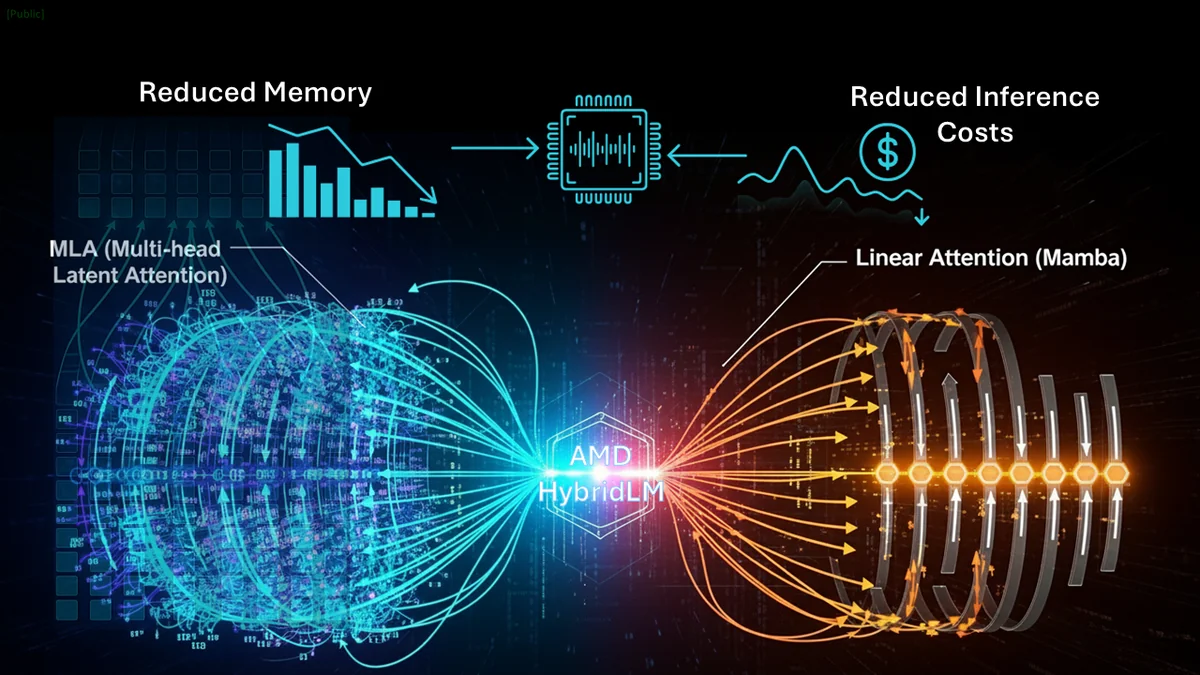
AMD-HybridLM: Towards Extremely Efficient Hybrid Language Models
Explore AMD-HybridLM’s architecture and see how hybridization redefines LLM efficiency and performance without requiring retraining from scratch

Introducing AMD EVLM: Efficient Vision-Language Models with Parameter-Space Visual Conditioning
A novel approach that replaces visual tokens with perception-conditioned weights, reducing compute while maintaining strong vision-language performance.

Introducing Instella-Math: Fully Open Language Model with Reasoning Capability
Instella-Math is AMD’s 3B reasoning model, trained on 32 MI300X GPUs with open weights, optimized for logic, math, and chain-of-thought tasks.

GEAK: Introducing Triton Kernel AI Agent & Evaluation Benchmarks
AMD introduces GEAK, an AI agent for generating optimized Triton GPU kernels, achieving up to 63% accuracy and up to 2.59× speedups on MI300X GPUs.

Instella-T2I: Open-Source Text-to-Image with 1D Tokenizer and 32× Token Reduction on AMD GPUs
Explore Instella-T2I: AMD’s open-source text-to-image model, built on MI300X GPUs with novel tokenizer and LLM-based encoder for scalable image generation.

Introducing Instella-Long: A Fully Open Language Model with Long-Context Capability
Learn about Instella-Long: AMD’s open 3B language model supporting 128K context, trained on MI300X GPUs, outperforming peers on long-context benchmarks.

Beyond Text: Accelerating Multimodal AI Inference with Speculative Decoding on AMD Instinct™ MI300X GPUs
This blog shows you how to speedup your multimodal models with AMD’s open-source PyTorch tools for speculative decoding on MI300X GPUs

Instella-VL-1B: First AMD Vision Language Model
We introduce Instella-VL-1B, the first AMD vision language model for image understanding trained on MI300X GPUs, outperforming fully open-source models and matching or exceeding many open-weight counterparts in general multimodal benchmarks and OCR-related tasks.

Introducing Instella: New State-of-the-art Fully Open 3B Language Models
AMD is excited to announce Instella, a family of fully open state-of-the-art 3-billion-parameter language models (LMs). , In this blog we explain how the Instella models were trained, and how to access them.

Enhancing AI Training with AMD ROCm Software
AMD's GPU training optimizations deliver peak performance for advanced AI models through ROCm software stack.